



A Tale of Two 'Days'
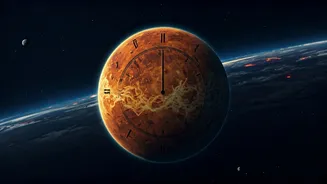
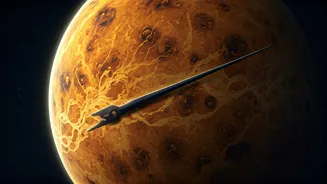
The headline's claim sounds impossible until you realize there are two ways to measure a 'day.' On Earth, they're nearly identical, but on Venus, they're wildly different. The first type is a 'sidereal day'—the time it takes for a planet to complete one
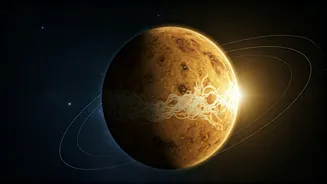
full 360-degree rotation on its axis. For Venus, this takes a mind-boggling 243 Earth days. Now, consider its 'year'—the time it takes to orbit the Sun. Venus whips around the Sun in just 225 Earth days. So, by this measure, a single spin (a sidereal day) on Venus is indeed longer than its entire year. However, the 'day' we experience—from one sunrise to the next—is called a 'solar day.' Because Venus rotates backward while orbiting the sun, its solar day is much shorter, clocking in at around 117 Earth days. Still an incredibly long time to wait for breakfast.
The Sun Rises in the West
Adding to the strangeness, Venus spins 'retrograde,' or backward, compared to Earth and most other planets in our solar system. If you could stand on its surface (a terrible idea, which we'll get to), you would see the Sun rise in the west and set in the east. This backward, sluggish rotation is a key ingredient in its day-year paradox. While other planets were set spinning in a counter-clockwise direction by the swirling disk of gas and dust that formed our solar system, something knocked Venus off course. This unusual motion means that its spin is working against its orbit from a solar perspective, which helps create the peculiar length of its solar day.
Why is Venus So Slow?
Scientists don't have a single, definitive answer, but two major theories dominate the conversation. The first is the 'giant impact' hypothesis. Early in its history, Venus may have been struck by a massive planet-sized object that not only slowed its rotation to a crawl but may have reversed it entirely. A planetary collision of this magnitude would have been a cataclysmic event, reshaping the world forever. The second theory points to Venus's own atmosphere. The planet is shrouded in an incredibly dense, heavy blanket of carbon dioxide, with pressures on the surface 90 times greater than Earth's. Some models suggest that powerful atmospheric tides, created by solar heating, have acted like a brake over billions of years, generating so much friction against the surface that they gradually slowed the planet's spin to its current, leisurely pace.
Life in a Furnace
This slow rotation contributes to Venus's status as the most inhospitable planet in the solar system. The same thick, heavy atmosphere that might be slowing the planet down has also created a runaway greenhouse effect, trapping heat and raising surface temperatures to an average of 864°F (462°C)—hot enough to melt lead. While the long days and nights might suggest extreme temperature differences, this crushing atmosphere is brutally efficient at distributing heat. The entire planet, from the day side to the night side, from the equator to the poles, remains at a fairly constant, furnace-like temperature. There is no relief, no cool night to escape the blistering heat. It's a world permanently stuck on high, a hellish landscape defined by its extreme pressure, heat, and bizarrely long days.