


Earth's Invisible Force Field
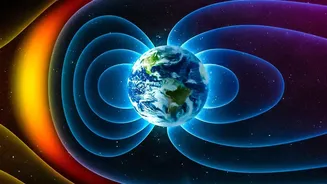
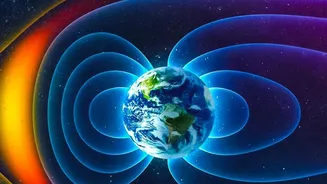
Deep within our planet, the churning of its liquid iron outer core generates a powerful magnetic field. This field extends far out into space, creating a vast, protective bubble known as the magnetosphere. This region is where Earth's magnetic influence
is dominant over the magnetic fields of interplanetary space. Without this shield, our atmosphere would be stripped away, and the surface would be bombarded with deadly radiation, making life as we know it impossible. Think of it as the planet's first and most important line of defense against the harsh environment of space. In a perfect vacuum, this field would extend infinitely, but it exists in a dynamic environment, constantly pushed and shaped by forces from our star.
The Sun's Constant Barrage
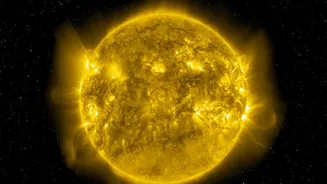
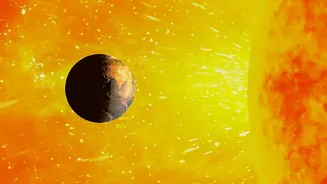
The Sun continuously emits a stream of charged particles—mostly protons and electrons—called the solar wind. This isn't a gentle breeze; it's a supersonic plasma that travels at speeds averaging over a million kilometres per hour, carrying with it a portion of the Sun's own magnetic field. This solar wind flows outward in all directions, interacting with every planet in the solar system. The intensity and speed of the wind can vary, especially during events like solar flares or coronal mass ejections, which can send even more powerful blasts of energy and matter hurtling toward Earth.
The Point of Impact
When the supersonic solar wind encounters the obstacle of Earth's magnetosphere, it can't simply pass through. The collision creates a shockwave, much like the wave that forms at the bow of a ship moving through water. This boundary is fittingly called the bow shock. Here, the solar wind is abruptly slowed, heated, and deflected. The region between the bow shock and the magnetosphere proper is called the magnetosheath, a turbulent area where solar wind plasma flows around Earth's magnetic shield. The actual edge of our magnetosphere, where the pressure of the solar wind is balanced by the outward pressure of Earth's magnetic field, is a boundary known as the magnetopause.
The Great Compression
The core of the distortion happens right at the magnetopause on the side of Earth facing the Sun—the 'dayside'. The relentless pressure from the incoming solar wind physically compresses the magnetosphere, pushing it inward. Instead of extending far out, the dayside of the magnetic shield is squashed, typically confined to a distance of about 10 Earth radii from our planet's center. This compression is dynamic; as the pressure from the solar wind fluctuates, the magnetopause moves inward and outward in response. Stronger solar winds push it closer to Earth, while weaker winds allow it to expand. This constant push creates a turbulent, rippling boundary as the two powerful magnetic forces jostle for dominance.
The Night-Side Stretch
While the sun-facing side gets compressed, the opposite happens on the 'night-side'. As the solar wind flows past Earth, it drags the magnetosphere's field lines with it, stretching them into a long, tail-like structure called the magnetotail. This tail can extend for hundreds of Earth radii, far beyond the orbit of the Moon. This dramatic stretching on one side and compression on the other illustrates just how profoundly the solar wind distorts our planet's magnetic shield, transforming it from a simple dipole shape into a dynamic, comet-like structure.
Why This Cosmic Battle Matters
Understanding these interactions is crucial for what's known as space weather. While the magnetosphere protects us, it's not impenetrable. During intense events, solar wind energy and particles can be transferred into our magnetic environment, powering the beautiful auroras but also posing risks. These interactions can disrupt satellites, impact communication networks, and even threaten power grids on the ground. Missions like NASA's Magnetospheric Multiscale (MMS) mission are dedicated to studying these processes, using multiple spacecraft to get a detailed, three-dimensional view of how our magnetic shield holds up against the solar wind.