



Why August is the Beginning of Saturn Season
While Saturn’s absolute best performance of 2026 will be in early October when it reaches opposition, August is the month it truly returns to the evening stage. All month, the planet rises a little earlier each night, making it conveniently visible without
having to stay up until the early morning hours. For many in India, August also signals the gradual end of the monsoon, bringing clearer, more stable skies perfect for astronomy. Think of this month as the opening act for the main event; Saturn is getting closer, brighter, and easier to observe, offering a fantastic preview of the celestial show to come. By late August, it is a prominent feature in the eastern sky soon after sunset, beckoning you to take a closer look.
The Undeniable Allure of the Ringed Planet
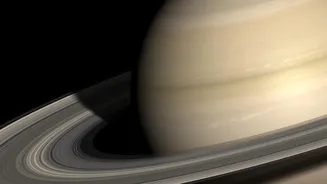
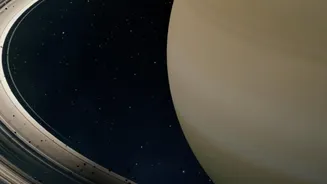
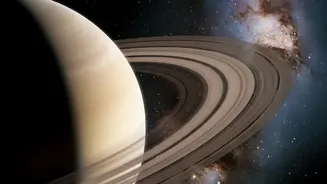
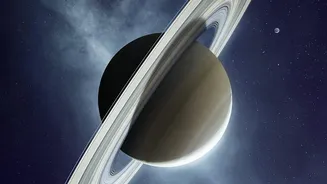
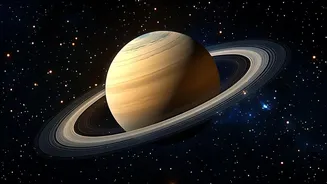
There's a reason Saturn is nicknamed the “jewel of the solar system” and a favourite among amateur astronomers. While Jupiter is bigger and Mars is closer, seeing Saturn’s rings through a telescope for the first time is a truly unforgettable experience. What looks like a single point of light to the naked eye resolves into a stunning, three-dimensional vision: a pale golden globe, delicately encircled by its famous rings. These rings, composed of countless particles of ice and rock, stretch across a distance nearly as vast as that between the Earth and the Moon, yet are incredibly thin. This breathtaking sight transforms a simple act of stargazing into a profound connection with the cosmos, making Saturn a must-see for anyone with even a passing interest in the night sky.
How to Locate Saturn in the Night Sky
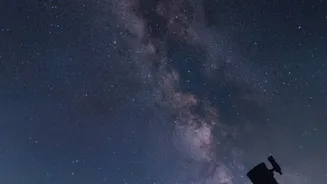
Finding Saturn in August 2026 is relatively straightforward. You don't need to be an expert to spot it. As darkness falls, look towards the eastern horizon. Saturn will rise as a bright, steady, yellowish-hued 'star' that doesn't twinkle as much as actual stars do. Throughout the night, it will climb higher, moving across the southern sky. For reference, it will be journeying through the constellation Pisces this year. If you're new to navigating the cosmos, a host of smartphone apps can act as your digital guide. Simply point your phone at the sky, and the app will identify Saturn for you, making the process of discovery quick and easy. For a special viewing opportunity, look for the Moon to pass closely by Saturn on the nights of August 30th and 31st.
What to Expect: Naked Eye, Binoculars, and Telescopes
Your view of Saturn will depend entirely on your equipment. With just your eyes, it appears as a bright, starlike object. A good pair of binoculars might reveal that the point of light is not perfectly round, perhaps hinting at the planet’s elongated shape caused by the rings. But the real magic happens with a telescope. Even a small, basic telescope with a magnification of 25x or more will clearly show the rings as a distinct structure separate from the planet itself. With a larger amateur telescope of 4 inches or more, on a night with steady air, you might be able to spot the Cassini Division—a dark gap within the rings. It is worth noting that in 2026, the rings are tilted at a relatively low angle towards us, which can make seeing finer details like this gap more challenging, but the overall view remains spectacular.
Simple Tips for the Best Stargazing Experience
To make the most of your night with Saturn, a little preparation goes a long way. First, try to get away from city light pollution. Even a short drive to a darker suburban or rural area will dramatically increase what you can see. Second, give your eyes time to adapt. It takes about 20-30 minutes for your eyes to become fully accustomed to the darkness, revealing fainter celestial objects. Avoid looking at your bright phone screen during this time; if you need light, use a torch with a red filter, as red light is less disruptive to your night vision. Finally, be patient. Weather and atmospheric steadiness play a huge role. Dress comfortably for the temperature, settle in, and just enjoy the simple, profound act of looking up.