






Peeking into Cosmic Nurseries
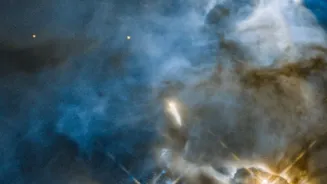
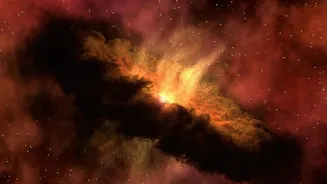
Imagine a vast, swirling donut of gas and dust circling a newborn star. This is a protoplanetary disk, the raw material from which entire solar systems are built. For decades, these cosmic nurseries were largely hidden from us, their secrets shrouded
by the very dust that forms planets. But the JWST, with its powerful infrared instruments, can pierce through these clouds, giving astronomers a front-row seat to the planet formation process. Recent observations are painting a vivid picture of these chaotic, beautiful environments where pebbles of ice and rock are beginning their long journey to becoming fully-fledged planets. These disks are where the action is, offering a glimpse into what our own solar system might have looked like 4.6 billion years ago.
The Race Against Time
Recent studies using the telescope have shown that planet formation is a frantic race against the clock. A team of astronomers recently observed 72 young, Sun-like stars and found that the gas needed to form giant planets like Jupiter is rapidly blown away by winds and radiation from the parent star. Early in a star's life, powerful magnetic winds drive material out of the disk. Later, as the star's own light becomes more intense, it heats and evaporates the remaining gas in a process called photoevaporation. This means gas giants have only a small window of a few million years to gather their massive atmospheres before the raw materials are gone forever. This discovery helps scientists understand the critical timing that determines whether a system will host gas giants or be limited to smaller, rocky worlds.
Water, Water Everywhere
One of the most exciting discoveries from Webb is the prevalence of water in these planet-forming zones. In a system called PDS 70, located 370 light-years away, astronomers detected a significant amount of water vapor in the inner disk—the very region where rocky, Earth-like planets are expected to form. This was a landmark finding, as it was the first time water had been spotted so close to a star in a disk already known to host planets. Previously, scientists weren't sure if water could survive the harsh radiation so near a young star. This discovery suggests that rocky worlds could be born with a ready supply of water, a key ingredient for life as we know it, rather than waiting for it to be delivered later by comets or asteroids.
Rewriting the Rulebook of Planet Formation
The unparalleled clarity of the JWST isn't just confirming old theories; it's also revealing surprising new details that are forcing a rethink of planetary science. Observations of systems like HL Tauri show complex structures of rings and gaps within the dust, strong evidence that Jupiter-sized planets are already carving out their orbits. By studying objects from edge-on systems, which show the disk's thickness, to face-on systems that reveal this gap structure, scientists are building a more complete 3D model of how planets grow. Furthermore, Webb's ability to analyse the chemical makeup of these disks has revealed a rich inventory of molecules, including simple organics, suggesting the building blocks of life are common ingredients in these stellar nurseries.