




A New Look at a Galactic Collision
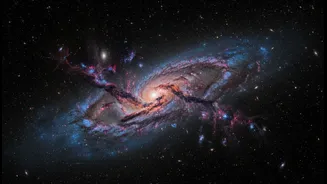
To celebrate the fourth anniversary of the James Webb Space Telescope's science operations, the agencies released a phenomenal new view of Centaurus A. Located about 11 million light-years away, this galaxy is a cosmic neighbour, but it’s anything but quiet.
Its peculiar shape is the result of a colossal merger between two galaxies billions of years ago. While the Hubble Space Telescope has studied it before, thick lanes of cosmic dust have always obscured its heart. Webb’s powerful infrared vision, however, cuts right through that dust. What was once a blur is now a tapestry of millions of individual stars. For the first time, scientists can study this galaxy star by star, essentially performing galactic archaeology to piece together its violent and active history.
Seeing Through the Dust
The new Webb image of Centaurus A is more than just a pretty picture; it's a scientific treasure trove. The telescope’s Mid-Infrared Instrument (MIRI) reveals the galaxy's intricate dust structures, which glow in baffling shapes that challenge astronomers. At the galaxy's core, a supermassive black hole is actively feeding on surrounding material, launching powerful jets that shape the entire system. The data reveals how this central black hole can both trigger intense star formation by compressing gas, and also stunt it by blowing away the raw materials. By comparing this view to previous ones from the Spitzer Space Telescope, the leap in technology is clear. Where Spitzer saw large structures, Webb sees fine details and individual stars, transforming our understanding of how active galaxies evolve.
A Crimson Nursery of Baby Stars
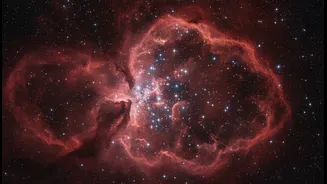
It’s not just Webb grabbing the headlines. The venerable Hubble Space Telescope also contributed a stunning new image of a region called LH 95. Located in the Large Magellanic Cloud, a dwarf galaxy that orbits our own Milky Way, LH 95 is a bustling stellar nursery. The image is a breathtaking scene of brilliant blue and white stars sparkling against crimson clouds of hydrogen gas, resembling fireworks in drifting smoke. Hubble's observations identified approximately 2,500 young stars that are still in the process of growing. These pre-main-sequence stars are still pulling in gas and dust from the disks that surround them. Once their cores get hot and dense enough, they will ignite nuclear fusion and become fully-fledged stars.
A Sparkler as Old as the Universe
In another release, Hubble captured a patriotic-looking field of red, white, and blue stars to commemorate the United States' 250th anniversary. The object, a globular cluster named NGC 6426, is one of the oldest collections of stars in our galaxy. Estimated to be around 13 billion years old, it formed not long after the universe itself began. These ancient star swarms are cosmic fossils that give us clues about the early universe. Scientists found that the stars in NGC 6426 have a very low concentration of elements heavier than hydrogen and helium, which is what the universe was mostly made of after the Big Bang. Studying such relics helps us understand how the first stars and galaxies formed and seeded the cosmos with the heavier elements needed for planets and life.