




From Textbooks to Headsets
Imagine an engineering student, not hunched over a textbook diagram of a jet engine, but standing on a virtual tarmac, able to walk around a full-scale digital twin of a Boeing 787. They can ‘touch’ the fuselage, zoom into the landing gear, and even perform
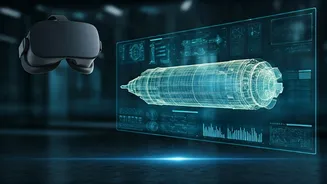
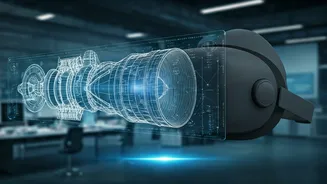
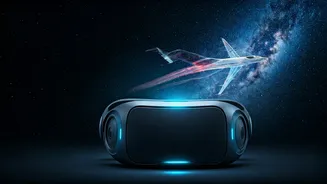
a pre-flight check. This is the promise of the VR classroom. Instead of relying solely on theory, students don a VR headset and are instantly immersed in a highly detailed, interactive environment. These are not simple video games; they are sophisticated digital replicas of aircraft, control towers, and weather systems, designed to make abstract aerospace concepts tangible and intuitive. This shift allows for a level of experiential learning that was previously impossible without access to multi-million dollar physical simulators or actual aircraft.
The AI Co-Pilot
The virtual reality environment sets the stage, but it's artificial intelligence that brings the lesson to life. The “AI” in these simulations acts as a dynamic, intelligent instructor. It goes far beyond a pre-programmed flight path. The AI can introduce unexpected challenges, like a sudden engine failure, a flock of birds, or a sudden change in wind shear—scenarios that are too dangerous to replicate in initial real-world training. More importantly, the AI monitors the student's every action. It analyses their response times, decision-making processes, and adherence to protocol. Did they follow the emergency checklist correctly? Did they overcorrect their steering? The system provides instant, data-driven feedback, highlighting errors and suggesting improvements. It can even adapt the difficulty in real time, making the simulation harder as the student’s skills improve, ensuring they are always learning at the edge of their capabilities.
Safer Skies, Smarter Students
The most obvious benefit is safety. Students can crash a virtual plane a hundred times with zero consequence, learning valuable lessons from each failure. This freedom to fail is a powerful educational tool, encouraging experimentation and building muscle memory for emergency procedures. Beyond safety, the economic advantages are significant. VR simulations eliminate the need for fuel, aircraft maintenance, and runway time, drastically reducing the cost of training a pilot or aerospace engineer. This democratises access to high-quality training, making it available to more institutions and students. Furthermore, it allows for endless repetition. A pilot-in-training can practice a difficult landing in a crosswind dozens of times in one afternoon—a feat that would be impractical and prohibitively expensive in the real world.
The Reality of Virtual Training
Despite the immense potential, VR training is not a complete replacement for hands-on experience—at least not yet. Aviation regulators worldwide still mandate a minimum number of real flight hours to earn a pilot's license. The technology is primarily a powerful supplement, designed to make trainees better prepared before they ever step into a real cockpit. There are also practical hurdles. High-fidelity VR systems require significant computational power and investment in hardware. Developing accurate, physics-based simulation software is a complex and expensive undertaking. Additionally, some users experience 'simulator sickness,' a form of motion sickness that can limit the duration of training sessions. As the technology matures and becomes more affordable, these barriers are expected to lower, but for now, they represent the key challenges to widespread adoption.
India's Ascent in Aero-Tech
For a nation like India with one of the fastest-growing aviation markets in the world, this technology is more than a novelty; it's a strategic necessity. The country faces a massive demand for skilled pilots, maintenance crews, and aerospace engineers. Integrating VR and AI into the curricula of premier institutions like the IITs and private aviation academies could dramatically accelerate the training pipeline. It can help produce a new generation of professionals who are not only theoretically sound but also have practical experience with a wide range of scenarios before their first day on the job. By embracing these next-generation tools, India can enhance its training standards, improve safety, and position itself as a global leader in aerospace education and innovation.