


A Telescope That Sees Through Time and Dust
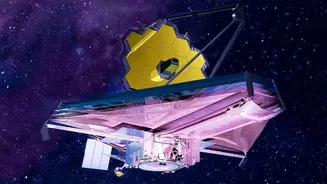
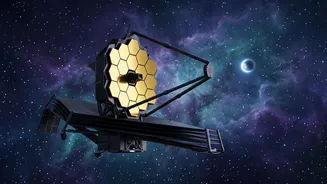
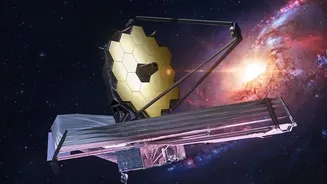
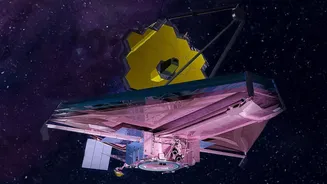
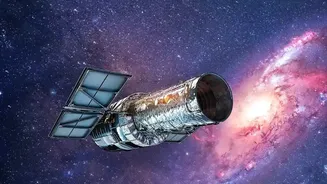
The James Webb Space Telescope (JWST), an international collaboration led by NASA, is not just another powerful eye in the sky; it's a veritable time machine. By observing in infrared light, it can peer through the dense clouds of gas and dust that shroud
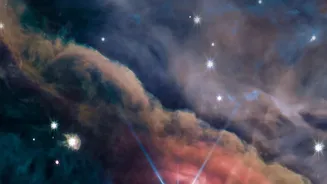
stellar nurseries—regions where stars and their planets are born. Before Webb, these chaotic, dusty environments were largely opaque to us. Now, the telescope’s exquisite sensitivity is pulling back the curtain on the very first stages of planetary development, allowing scientists to witness processes that have been theorized for decades but never directly observed in such detail. Recent observations have provided some of the most profound insights yet, focusing on the building blocks of planets and the environments in which they grow.
A Census of Our Solar System’s Ancestors
In a landmark study, astronomers used Webb to conduct the largest-ever census of small, icy bodies at the edge of our solar system. These Trans-Neptunian Objects (TNOs) are frozen relics from the solar system's earliest days, preserved in a deep freeze far beyond Neptune. They are considered the leftover building materials from which planets like Earth were made. The JWST, in tandem with the Hubble Space Telescope, identified 27 new TNOs, some as small as six miles wide—far smaller than what could previously be detected. This provided a clearer picture of how common these city-sized planetesimals are, offering crucial clues about the initial stages of planet assembly. This deep look into our own cosmic backyard helps us understand the raw materials that were available when our world was just beginning to form.
The 'Born Big' Theory Gains Ground
The results from the TNO survey have thrown significant weight behind a planet formation theory known as the 'born big' model. For years, scientists debated whether planets grew slowly, with tiny dust particles gradually clumping together over millions of years, or if they formed rapidly when large clouds of pebble-sized material collapsed under their own gravity to form large bodies quickly. The new data shows a surprising lack of smaller, dust-like fragments in the Kuiper Belt, which one would expect if planets grew through countless small collisions. Instead, the prevalence of larger, city-sized objects suggests that the building blocks of planets may have indeed 'born big', forming rapidly into substantial objects from the outset. This insight helps explain how giant planets could have formed so quickly in the early solar system.
A Race Against the Clock
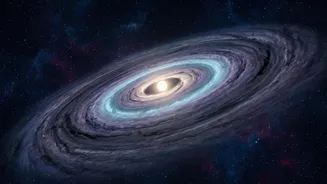
Another groundbreaking study using Webb has shown that planet formation is a frantic race against time. By studying 72 young, sun-like stars, researchers found that the protoplanetary disks—the swirling platters of gas and dust that planets form from—are dispersed by powerful winds from the central star much faster than previously understood. This sets a strict deadline for planet formation. Gas giants, in particular, must gather their massive atmospheres before the disk’s gas is blown away. The research shows how the dispersal process changes over time, starting with magnetically driven jets and later transitioning to pressure from the star's own radiation. This discovery fundamentally alters our timeline for how and when different types of planets can emerge in a young solar system.
Finding Water Where It Matters Most
Perhaps most excitingly, Webb has also made the first-ever detection of water vapor in the inner, rocky-planet-forming zone of a protoplanetary disk already known to host planets. In the PDS 70 system, located 370 light-years away, JWST identified water in the very region where worlds similar to Earth are thought to be assembling. While water has been seen in other disks, finding it so close to the star in a system where planets are actively forming is an unprecedented breakthrough. This suggests that rocky planets could have access to water, a key ingredient for life, from the very beginning of their formation. It strongly supports the theory that Earth’s water may not have come from later cometary impacts but was delivered by icy pebbles that drifted inward from the colder, outer regions of the solar system.