


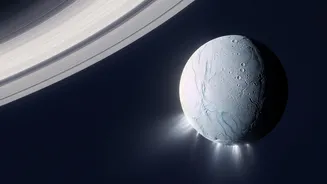

A Moon of Great Promise
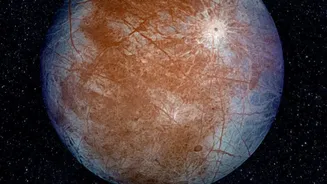
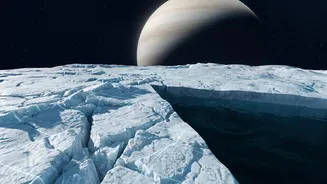
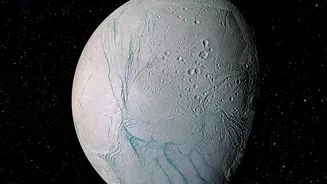
Ever since Galileo Galilei first spotted it in 1610, Europa has captivated astronomers. It is the smoothest solid object in our solar system, suggesting its surface is constantly being renewed. The most compelling evidence for a subsurface ocean came
from NASA's Galileo mission in the 1990s, which detected a magnetic field within Europa that is best explained by a global, electrically conductive fluid, like a salty ocean. This internal heat isn't from the Sun, but from the immense gravitational pull of Jupiter, which stretches and flexes the moon, a process called tidal heating. This process could keep the hidden ocean from freezing solid and potentially power hydrothermal vents on the seafloor, similar to those on Earth that teem with life.
The Interplanetary Detective
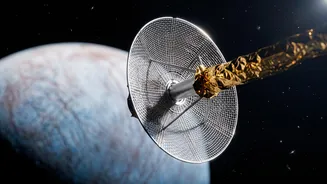
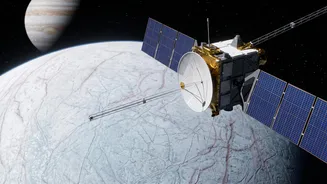
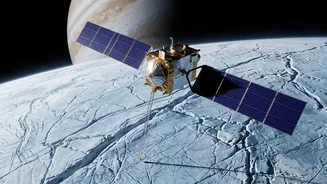
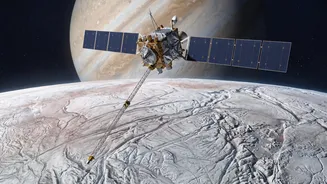
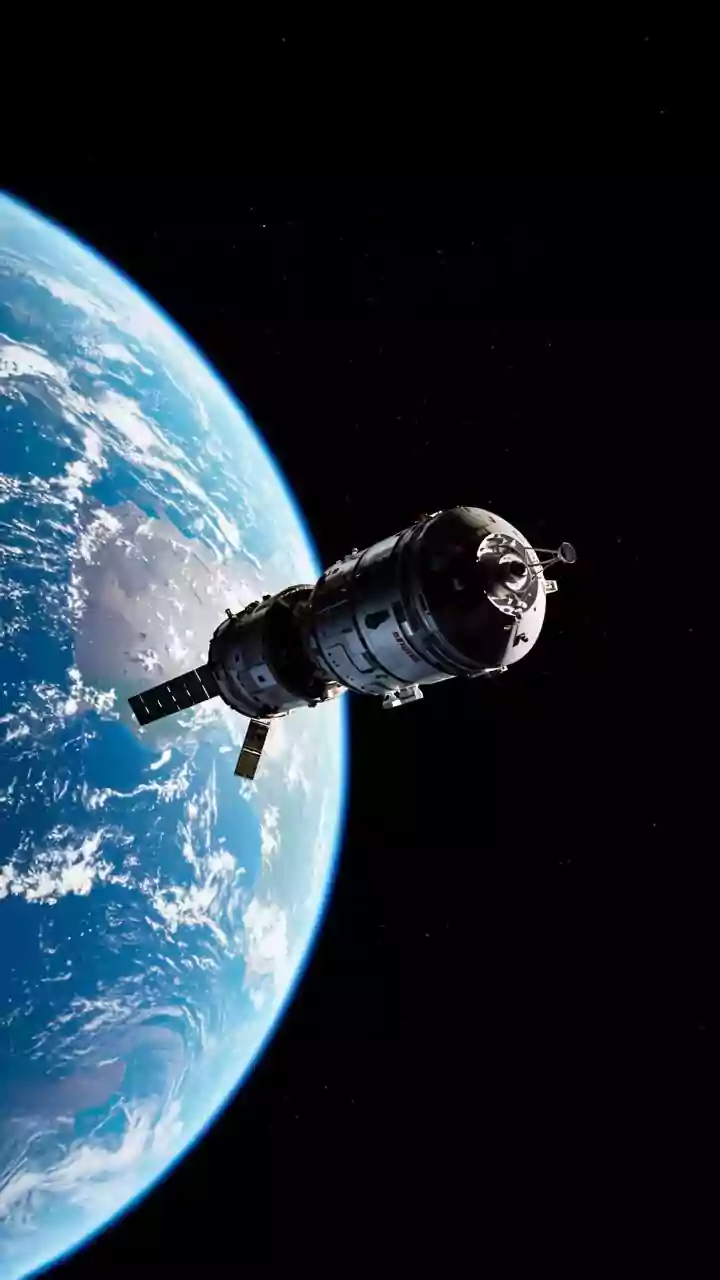
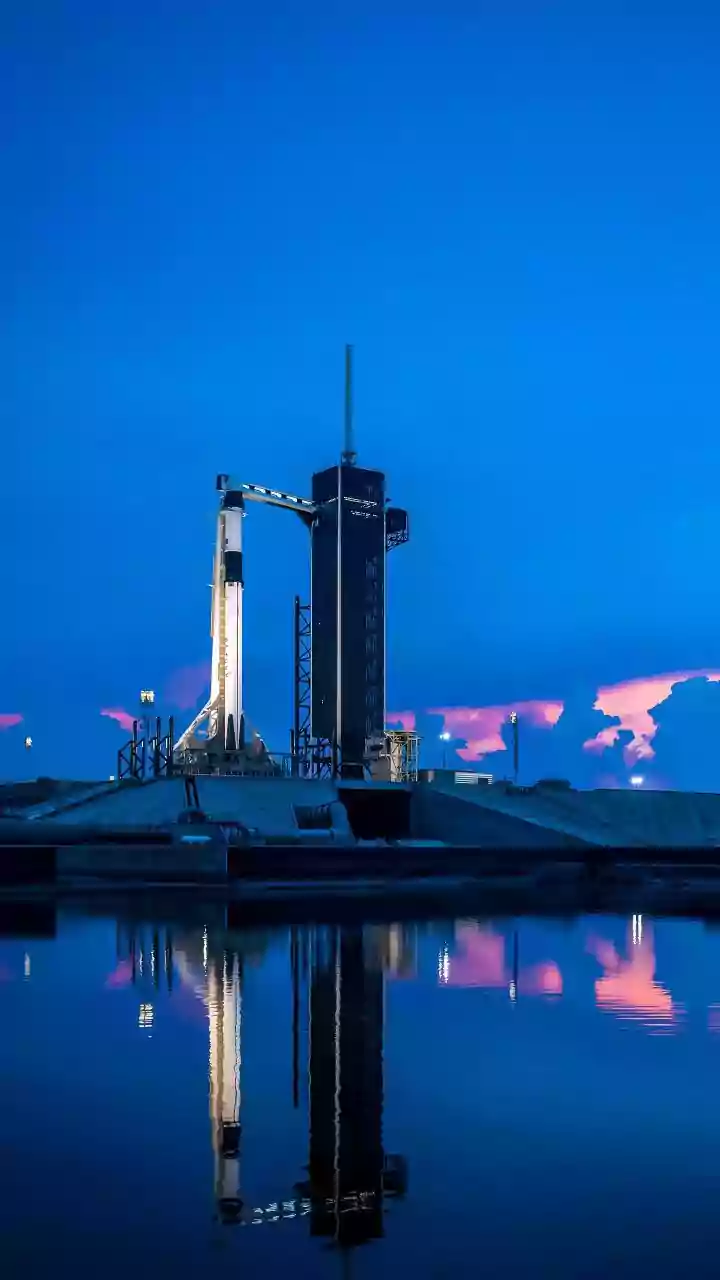
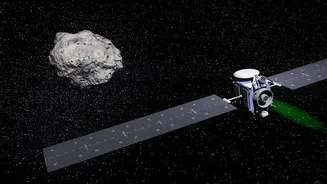
To investigate these tantalising clues, NASA launched the Europa Clipper spacecraft on October 14, 2024. It's the largest spacecraft NASA has ever built for a planetary mission, spanning the length of a basketball court with its solar arrays deployed. The probe is currently on a long and complex journey, scheduled to perform a gravity-assist flyby of Earth in December 2026 before arriving in orbit around Jupiter in April 2030. Instead of orbiting Europa directly and exposing itself to Jupiter's intense radiation, Clipper will make a series of nearly 50 close flybys of the moon, some as low as 25 kilometres above the surface. This strategy allows it to gather detailed data while protecting its sensitive instruments.
A Toolkit for Discovery
Europa Clipper is equipped with a suite of nine advanced science instruments designed to peer beneath the ice. The Radar for Europa Assessment and Sounding: Ocean to Near-surface (REASON) instrument will act like a powerful ice-penetrating radar, aiming to determine the thickness of the ice shell and locate the ocean itself, or any pockets of water trapped within the ice. Another key instrument, the Europa Clipper Magnetometer (ECM), will measure the strength and direction of the moon's magnetic field with high precision. By studying how the field changes as Jupiter's own massive magnetic field sweeps past, scientists can confirm the ocean's existence and even estimate its depth and salinity. To 'taste' the moon, the SUrface Dust Mass Analyzer (SUDA) will scoop up and analyse tiny particles of ice and dust ejected from Europa's surface. If there are plumes of water venting into space, as some evidence suggests, SUDA could directly sample the ocean's composition without ever needing to land.
Searching for Habitability, Not Life
It's important to understand that Europa Clipper is not a life-detection mission. Its primary goal is to determine if Europa has the necessary ingredients for life as we know it: liquid water, essential chemical elements, and a source of energy. By thoroughly characterising the ocean, mapping the moon's geology, and analysing the composition of its surface and thin atmosphere, the mission will create a detailed picture of Europa's environment. This will help scientists understand its potential to support life and guide future missions that might one day search for organisms directly. The mission's findings will help determine whether this icy world is, or ever was, a habitable environment, a crucial step in our quest to find life beyond Earth.