






The Elusive Cosmic Messengers
Neutrinos are some of the mysterious and abundant particles in the universe. They have almost no mass, no electric charge, and interact so weakly with other matter that they can fly straight through entire planets and stars without leaving a trace. While
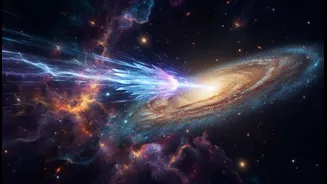
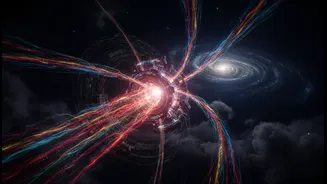
the Sun is a major source of low-energy neutrinos, the origins of the most powerful, high-energy versions have long been a profound puzzle for astrophysicists. Because they travel in straight lines, unimpeded by magnetic fields or cosmic dust, these high-energy neutrinos act as perfect cosmic messengers, carrying information directly from their violent birthplaces. If scientists could only trace their paths back to the source, they could unlock secrets about the most extreme processes in the universe, like what happens inside supermassive black holes or exploding stars.
A Detective Story Buried in Ice
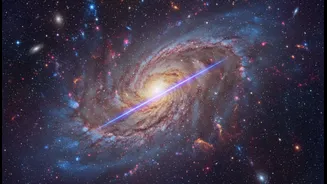
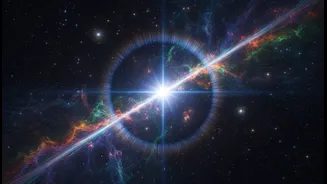
The primary tool in this cosmic detective story is the IceCube Neutrino Observatory, a massive telescope buried a mile deep in the Antarctic ice. It isn't a telescope in the traditional sense; instead of light, it looks for the faint blue flashes produced when a rare high-energy neutrino happens to collide with an atom in the ice. In 2021, IceCube detected one such particle, catalogued as IC 210922A. An alert was immediately sent to astronomers around the world, triggering a frantic search for any corresponding flash of light—gamma rays, X-rays, or optical light—in the same patch of sky. For years, the prime suspects for these events were blazars—enormous galaxies with supermassive black holes at their cores, shooting jets of particles directly at Earth. But this time, the initial follow-ups found nothing.
Introducing the Shadow Blaster
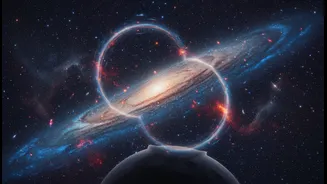
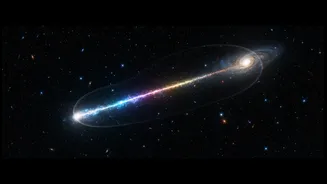
Days after the initial alert, a team of astronomers pointed telescopes in Hawaii toward the target region and spotted something unusual. It was an incredibly bright, distant galaxy that had been nicknamed "Shadow Blaster." Lying roughly 11 billion light-years from Earth, this object is not a blazar. Instead, it’s a dusty, star-forming galaxy, a cosmic nursery churning out new stars at a furious rate. Its official designation is JCMT0402-0424, and its incredible distance means we are seeing it as it was during "cosmic noon," a period in the early universe when star formation was at its peak. A lucky break made its detection possible: the galaxy’s light is magnified by the gravity of another massive galaxy in front of it, a phenomenon known as gravitational lensing.
A New Window on the Universe
The identification of Shadow Blaster as a potential neutrino source is a landmark discovery. It's the first time a dusty, star-forming galaxy has been directly linked to a high-energy neutrino event. While blazars are still considered major neutrino producers, this finding suggests there is a whole new class of cosmic particle accelerators to investigate. Theoretical models have long predicted that the dense, gas-rich environments inside these intensely star-forming galaxies would be efficient neutrino factories, but this is the first direct evidence. This discovery doesn't just add a new suspect to the list; it could fundamentally change our understanding of the high-energy universe. According to researchers, this population of dusty galaxies might be responsible for a significant portion—perhaps up to 20%—of all the high-energy neutrinos that constantly bombard Earth.