
To unlock the secrets of the Sun’s violent outbursts, two advanced space missions are now working in tandem. India’s Aditya-L1 and the European Space Agency's Proba-3 are combining their unique capabilities to give us a powerful new perspective.
Two Missions, One Star
The Sun
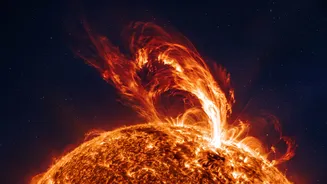
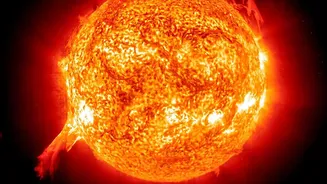
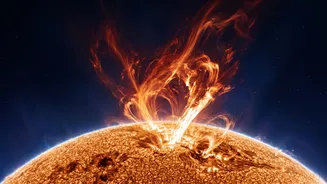
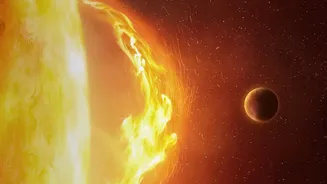
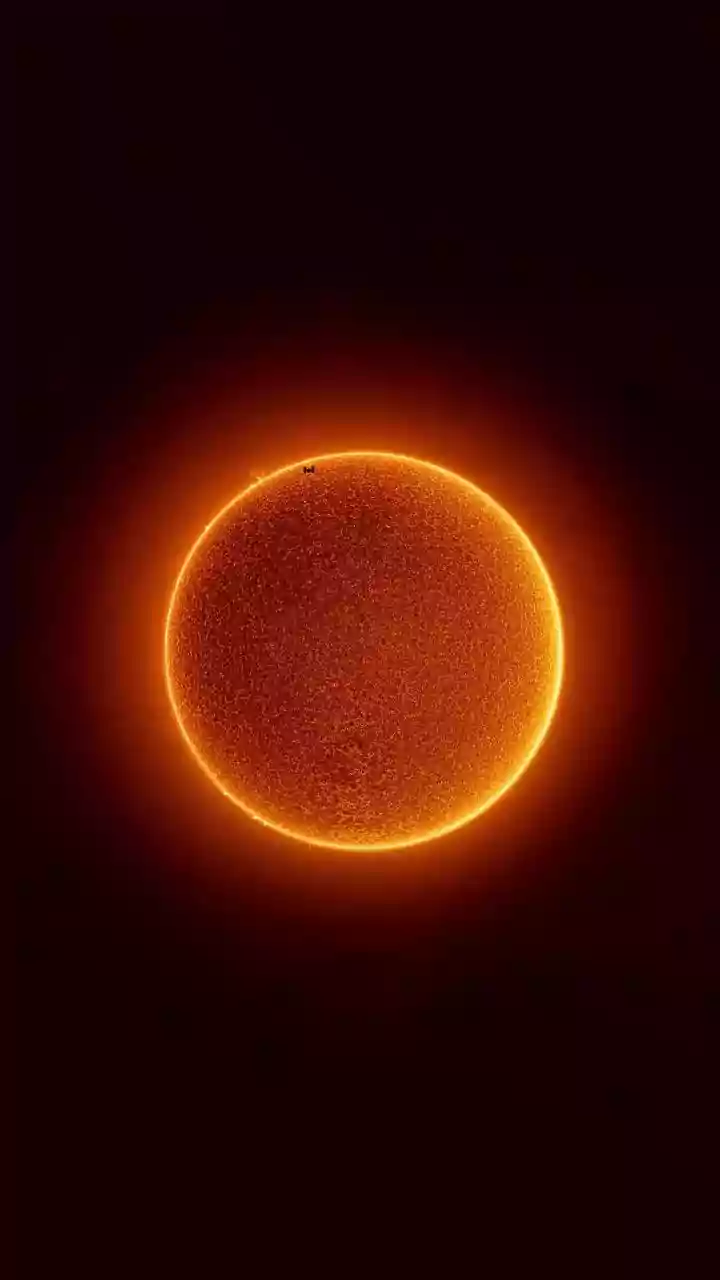
may appear as a steady source of light from Earth, but its outer atmosphere, the corona, is a chaotic theatre of violent eruptions. These events, known as Coronal Mass Ejections (CMEs), can hurl vast quantities of magnetised plasma into space. When aimed at Earth, they can disrupt satellites, power grids, and communication systems. Understanding how these eruptions begin is crucial, but observing them in their infancy, close to the Sun's blindingly bright surface, has always been a major challenge for scientists. Now, a collaboration between the Indian Space Research Organisation (ISRO) and the European Space Agency (ESA) is changing the game. By combining data from India's Aditya-L1 solar observatory and ESA’s Proba-3 mission, researchers are getting a more complete picture of CMEs than ever before.
Aditya-L1: India’s Unblinking Eye
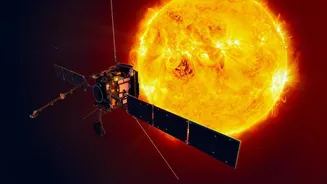
Launched in September 2023, Aditya-L1 is India's first dedicated solar mission. It operates from a unique vantage point in space called Lagrange Point 1 (L1), about 1.5 million kilometres from Earth. This position allows for a continuous, unobstructed view of the Sun. Among its seven specialised instruments is the Visible Emission Line Coronagraph (VELC). A coronagraph is an instrument designed to block the bright face of the Sun so that the much fainter corona can be studied. VELC is special because it performs spectroscopy, which means it analyses the properties of the light from the corona to determine the temperature, velocity, and density of the plasma. This provides critical diagnostic information about the material erupting from the Sun.
Proba-3: Engineering an Eclipse in Space
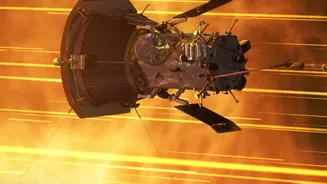
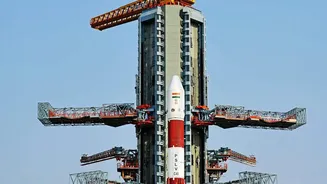
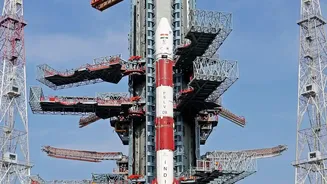
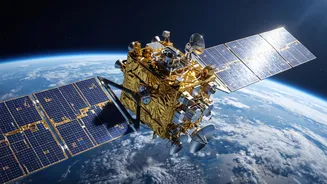
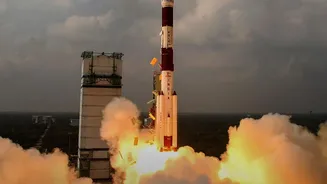
ESA's Proba-3, launched in December 2024 aboard an Indian PSLV rocket, is a mission of incredible technical precision. It consists of two separate spacecraft flying in perfect formation, about 150 metres apart. One spacecraft, the 'Occulter', flies in front and uses a disc to block the Sun's light, casting a precise shadow onto the second spacecraft, the 'Coronagraph'. This creates a sustained artificial solar eclipse, allowing its ASPIICS instrument to capture incredibly sharp images of the corona very close to the solar limb, a region usually obscured by glare. While Aditya-L1's VELC studies the 'what' (the physical properties of the plasma), Proba-3's ASPIICS captures the 'where' and 'how' (the shape, structure, and movement of the eruption).
A Powerful Scientific Synergy
The real breakthrough comes when data from these two missions are combined. Scientists at the Indian Institute of Astrophysics and their international partners recently analysed two CMEs that occurred in September 2025, which were observed by both missions simultaneously. The results, published in the journal 'Astronomy & Astrophysics', demonstrate the power of this collaboration. ASPIICS provided sharp images to accurately estimate the CME's shape, mass, and speed, while VELC's spectroscopic data provided independent measurements of the erupting gas's density and thermal energy. This dual approach allows scientists to crosscheck their findings and build a much more reliable and detailed model of how a CME evolves in its first moments. This partnership provides a more complete view than any single spacecraft could achieve alone.
Advancing Space Weather Prediction
This India–Europe collaboration is more than just an academic exercise. A deeper understanding of the origin and evolution of CMEs is vital for improving our ability to predict space weather. Violent solar events pose a tangible threat to our technology–dependent society. By studying the mass, speed, and energy of these eruptions right as they leave the Sun, scientists can better forecast their potential impact if they are heading toward Earth. The joint observations from Aditya–L1 and Proba–3 are providing crucial, missing information about the initial energy budget of CMEs, a key factor in their subsequent evolution. This partnership not only showcases India's growing capabilities as a major space power but also sets a new standard for international scientific cooperation in tackling some of the biggest questions about our solar system.