




More Than a Planet Counter
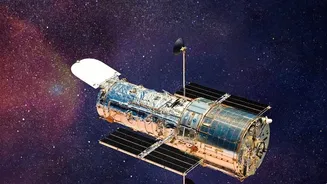
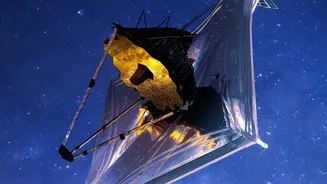
Set to launch in the mid-2020s, the Nancy Grace Roman Space Telescope is NASA's next great observatory, joining giants like Hubble and the James Webb Space Telescope. But Roman has a unique job. While finding thousands of new worlds beyond our solar system,
or exoplanets, is a major goal, its primary purpose is much grander. The mission is designed to tackle the most profound mysteries in physics: the nature of dark energy and dark matter. Unlike its predecessors, which often take incredibly detailed, zoomed-in photos, Roman has a panoramic field of view that is at least 100 times larger than Hubble's. This allows it to survey huge patches of the sky with incredible speed, creating vast maps of the cosmos. It's this large-scale survey capability that connects the search for individual planets to the grand structure and fate of the entire universe.
Einstein's Magnifying Glass
At the heart of Roman's planet-finding strategy is a phenomenon called gravitational microlensing. First predicted by Albert Einstein, it occurs when a star or planet passes almost directly in front of a more distant star from our point of view. The gravity of the foreground object acts like a natural magnifying glass, bending and amplifying the light of the background star. This causes a temporary, predictable spike in the background star's brightness. If the foreground star has a planet orbiting it, the planet’s own smaller gravity creates a second, much shorter and sharper blip on top of the main signal. By precisely measuring these light fluctuations, astronomers can deduce the presence of a planet, estimate its mass, and determine its distance from its star, all without ever seeing the planet directly. This method is especially powerful for finding planets that are far from their stars, in orbits similar to Jupiter or Saturn, or even worlds that have no star at all.
Finding the Galaxy's Lost Worlds
One of Roman’s most exciting prospects is its ability to find “rogue” planets. These are worlds that have been ejected from their original solar systems and now drift through the galaxy alone. Because they don't orbit a star, they are dark, cold, and nearly impossible to detect with traditional methods. Microlensing is the only practical way to spot them. By catching the fleeting gravitational signature of a rogue planet as it drifts in front of a distant star, Roman can build the first real census of these cosmic castaways. Scientists believe there could be trillions of these wandering worlds in our galaxy, potentially outnumbering stars 20 to one. Counting them and determining their average mass will provide crucial insights into the chaotic process of planet formation, helping us understand how many planets are violently kicked out of their planetary systems as they form.
From Planets to the Fabric of Spacetime
So how does a catalogue of planets help solve the mystery of dark energy, the enigmatic force causing the universe's expansion to accelerate? The answer lies in the sheer volume and precision of Roman's data. The telescope will observe hundreds of millions of galaxies and stars, creating a 3D map of the distribution of matter across the cosmos. By studying how galaxies are clustered and how light from distant objects is distorted by gravity (a technique called weak lensing), scientists can trace the history of cosmic expansion. This will help determine if dark energy is a constant force or if its strength has changed over time. Furthermore, the detailed map of matter, including the distribution of all those newly found rogue planets, will give us a clearer picture of how dark matter structures the universe, helping to narrow down what this invisible substance could be. Each planet found via microlensing becomes another data point in a giant cosmic experiment to test Einstein's theory of general relativity on a galactic scale.