



A Glimpse into the Cosmic Dawn
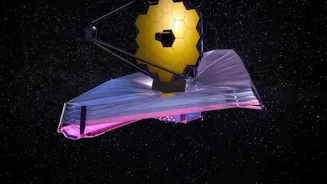
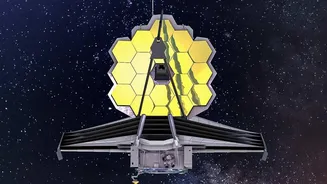
Launched in 2021, the James Webb Space Telescope was engineered to see the universe in infrared light. This is crucial because as the universe expands, the light from the most distant objects gets stretched from visible wavelengths into the infrared.
This capability allows Webb to peer through cosmic dust and look back to a time just a few hundred million years after the Big Bang, revealing the first stars and galaxies as they blinked into existence. For years, astronomers operated with a standard model of cosmology, which predicted that the first galaxies would be small, young, and take a long time to grow into the grand structures we see today. What Webb has found, however, is turning that tidy picture on its head.
Too Big, Too Soon
Across multiple deep-field observations, the JWST has consistently found galaxies in the early universe that are surprisingly bright, massive, and mature. Some of these galaxies, seen as they were just 500 to 700 million years after the Big Bang, appear to be as massive as our own Milky Way, a galaxy that had billions of additional years to develop. These findings challenge the standard ΛCDM (Lambda Cold Dark Matter) model, which simply doesn't account for such rapid growth. According to one study, for galaxies to reach this size so quickly, they would have had to convert nearly 100% of their available gas into stars—a rate far exceeding the 10% conversion efficiency typically observed in modern galaxies.
Cosmic Collisions and Voracious Black Holes
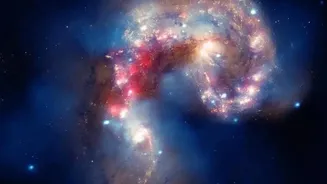
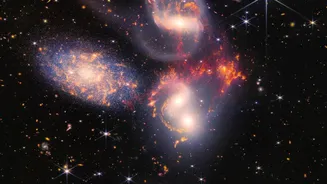
So how did these early systems grow so fast? The new images suggest a couple of powerful mechanisms were at play much earlier than anticipated. One answer is cosmic traffic jams. Webb has captured evidence of ongoing mergers between multiple galaxies when the universe was just 740 million years old. One observation identified a tightly packed collision of at least five galaxies happening 800 million years post-Big Bang. Such mergers would have accelerated star formation and the distribution of heavy elements far sooner than models predicted. Another key factor appears to be supermassive black holes. Webb is finding that gargantuan black holes were already in place in the first billion years of the universe. In fact, recent discoveries of objects dubbed "little red dots" suggest that some of these might be massive black holes that formed before their host galaxies, acting as seeds that rapidly pulled in gas to fuel explosive star birth.
Rewriting the Textbooks
These discoveries are not necessarily breaking our entire understanding of the Big Bang, but they are forcing a major revision of the astrophysics that followed. The early universe was evidently a much more dynamic and efficient factory for stars and galaxies than previously thought. Scientists are now exploring new theories to explain this accelerated timeline. Possibilities include a faster expansion of the universe shortly after the Big Bang, or simply that more matter was available for galaxy formation than was accounted for in older models. The presence of heavy elements like oxygen in very distant galaxies also points to faster-than-expected chemical enrichment from the first generations of stars. The clear takeaway is that the first few hundred million years of cosmic history were far from a slow and steady process.