



A New Southern Polygon Has Emerged
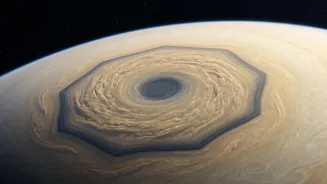
For decades, scientists were mesmerized by a massive, six-sided jet stream at Saturn’s north pole, known as 'the hexagon'. Many wondered why the south pole had no matching feature. But in a stunning recent discovery, scientists analyzing new Hubble Space
Telescope images announced the emergence of a ten-sided atmospheric wave, or 'decagon,' wrapped around the south pole. This feature was not seen by the Cassini spacecraft, which orbited the planet until 2017, suggesting it formed sometime between 2017 and 2023 when the pole was hidden from Earth's view. The find shows just how dynamic and changeable the gas giant’s atmosphere can be.
The Famous North Pole Hexagon
Long before the decagon was spotted, Saturn was famous for its northern hexagon. First seen by the Voyager probes in the 1980s, this massive six-sided pattern is a jet stream wider than two Earths. The winds within this structure move at over 320 kilometres per hour. While it might look artificial, scientists believe it is a naturally forming standing wave pattern in the atmosphere. Experiments in labs have even recreated similar polygonal shapes by spinning tanks of liquid at different speeds. Over the years, the hexagon has mysteriously changed colour from blue to gold, likely due to seasonal changes in sunlight creating haze.
Planet-Circling 'Great White Spots'
Roughly once every Saturnian year (about 30 Earth years), a colossal storm erupts in the planet's northern hemisphere. Known as a Great White Spot, this storm can grow to be as large as Earth itself before its tail stretches out and wraps around the entire planet. Unlike Jupiter’s Great Red Spot, which is a long-lived anticyclone, these Saturnian storms are powerful, convective thunderstorms that eventually dissipate. Scientists believe these periodic outbursts are caused by a complex cycle involving water vapour in the atmosphere, which leads to a massive build-up and release of energy over decades.
The Fastest Winds in the Solar System
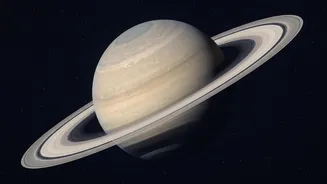
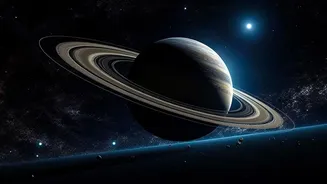
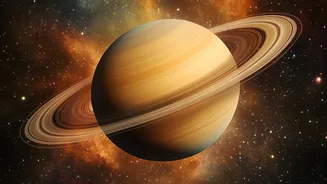
While Earth’s most powerful hurricanes feel destructive, their winds are no match for Saturn’s. The ringed planet is one of the windiest places in our solar system. Near the equator, winds in the upper atmosphere can reach a staggering 1,800 kilometres per hour (about 500 meters per second). This extreme speed is driven by a combination of the planet’s rapid rotation—a day on Saturn is only about 10.7 hours long—and the immense heat rising from its interior. These forces combine to create the distinct bands of yellow and gold clouds we see in images of the planet.
It Rains Helium from the Sky
Saturn has an internal mystery: it radiates about two and a half times more energy into space than it receives from the Sun. For years, scientists struggled to explain this excess heat. The leading theory today sounds like science fiction: helium rain. Deep within the planet's interior, immense pressure and low temperatures are thought to cause helium to condense into droplets that 'rain' down through the lighter liquid hydrogen. The friction from this falling helium rain generates heat, which then radiates out into space. This process not only warms the planet but may also be responsible for shaping its unique magnetic field.