




Unmasking the Shadow Blaster
The nickname 'Shadow Blaster' refers to the source of a powerful burst of neutrinos detected back in 2021. These neutrinos, which are mysterious, nearly massless particles that zip through the universe, were traced back to a galaxy 11 billion light-years
away. What made this source special was its invisibility in optical light; it was completely hidden by a thick shroud of cosmic dust. Because it was obscured (in shadow) yet was clearly the source of a powerful blast of particles, astronomers gave it its memorable moniker. The discovery was significant because scientists initially suspected the energy came from a supermassive black hole, the usual suspect for such high-energy events. Instead, observations pointed to something unexpected: an intense burst of star formation.
A Tale of Two Sources
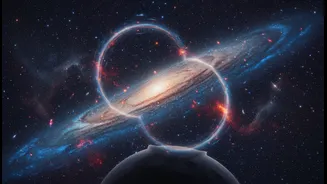
For years, the leading theory was that only the most extreme cosmic engines, like the supermassive black holes at the centers of active galaxies, could produce such high-energy neutrinos. The Shadow Blaster event challenges this idea. Data from observatories like the Atacama Large Millimeter/submillimeter Array (ALMA) showed no evidence of a black hole. Instead, they found a 'starburst' galaxy, a cosmic nursery churning out new stars at a furious rate. This suggests that such dusty, star-forming galaxies could be a major, previously hidden source of the high-energy neutrinos that pepper our universe. The discovery was aided by a cosmic coincidence known as gravitational lensing, where a massive galaxy in the foreground bent and magnified the light from the more distant Shadow Blaster, acting like a natural telescope.
The Power of a Nickname
There's no question that a name like 'Shadow Blaster' is more compelling than its official designation, JCMT0402−0424. In the competitive world of scientific research, a catchy name can be a powerful tool. It helps a complex discovery stand out, capture public imagination, and attract attention from both the media and funding bodies. Names like the 'Big Bang' (originally an insult) or the 'God Particle' (a publisher's invention) have proven incredibly effective at launching obscure concepts into the popular lexicon. This branding helps make abstract ideas more tangible. However, this is where the central tension arises. While great for communication, such nicknames can also oversimplify the science and, in some cases, create misleading expectations.
The Key Scientific Limit
The headline's caution about replacing scientific context is crucial here. The 'limit' of the Shadow Blaster isn't a failure, but a series of profound scientific questions and observational challenges. While it's a confirmed source, it raises more questions than it answers. How, exactly, does star formation accelerate particles to create such energetic neutrinos? The mechanism is not fully understood. Furthermore, detecting these sources is incredibly difficult precisely because they are shrouded in dust. The Shadow Blaster was only identifiable thanks to gravitational lensing, a rare alignment. This implies there could be a vast population of these neutrino factories across the universe that remain invisible to us, making it challenging to account for the total cosmic neutrino background that observatories like IceCube detect. The nickname, for all its appeal, doesn't convey this deep uncertainty and the immense difficulty of the research.
Clarity Over Catchiness
The debate over naming conventions in science is ongoing. Some argue that descriptive but dry labels are better for precision, while others embrace creative monikers to foster engagement. The story of the Shadow Blaster illustrates this perfectly. The name is a brilliant hook that draws us into a fascinating astronomical discovery. But the real science lies in the details: the surprising role of starburst galaxies, the limitations of our current detection methods, and the fundamental mysteries about neutrino production that still need to be solved. The nickname gets the conversation started, but it is the scientific context—the limits, the unknowns, and the painstaking work of researchers—that truly defines our understanding of the cosmos.