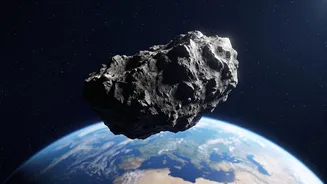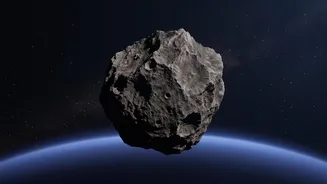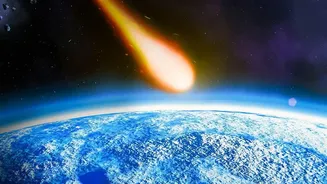






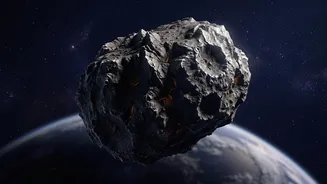
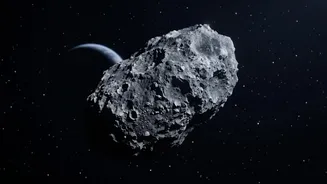
In the vast, quiet expanse of space, a tiny asteroid named 1998 KY26 is making a bit of noise. This small, fast-spinning rock is moving in a way that the simple pull of gravity from the Sun and planets cannot fully explain, puzzling scientists.
Meet Asteroid 1998 KY26
First,
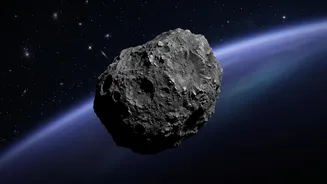
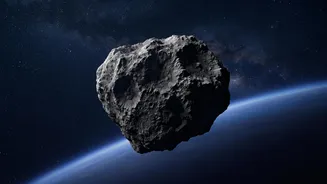
let's get acquainted with this celestial object. Discovered in 1998, 1998 KY26 is a Near-Earth Object (NEO), meaning its orbit brings it into Earth's neighbourhood. However, it's crucial to note that it poses no threat to our planet. The asteroid is incredibly small, estimated to be only about 11 metres (36 feet) in diameter—roughly the size of a large bus. What makes it particularly fascinating is its rotation; it spins on its axis once every 5.3 minutes, making it one of the fastest-rotating objects known in our solar system. This rapid spin for such a small body is unusual, as many asteroids are loose collections of rubble that would fly apart at such speeds. This suggests 1998 KY26 might be a single, solid piece of rock.
The Rules of Cosmic Motion
For the most part, the movements of planets, moons, and asteroids are governed by a predictable set of rules: the laws of gravity. An object's path, or orbit, is the result of the gravitational pull from every other massive body in the solar system, primarily the Sun. For centuries, astronomers have used these principles to forecast the positions of celestial objects with incredible accuracy. This is what's meant by 'simple gravitational expectations'. However, for smaller bodies like asteroids, gravity isn't the only force at play. Other, much weaker forces can introduce tiny, unexpected changes to their orbits over time.
A Mysterious Nudge
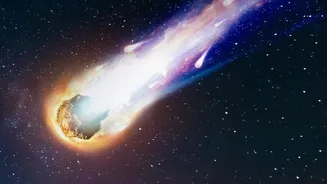
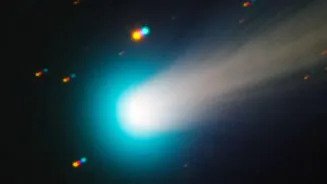
Recent observations have shown that 1998 KY26 is deviating from its gravity-defined path. It's experiencing a gentle but persistent acceleration that cannot be accounted for by gravitational forces alone. This isn't a dramatic speeding up, but a subtle, continuous nudge that alters its trajectory over time. One early theory proposed that 1998 KY26 might be a 'dark comet'. Comets get a push from jets of gas that escape as the Sun's heat sublimates their internal ice. A dark comet would do the same, but without producing a visible tail. However, recent modeling suggests the asteroid is too warm to have retained the kind of buried water ice needed to produce this effect over long periods.
The Yarkovsky Effect
If not outgassing, what could be pushing the asteroid? The leading suspect is a subtle phenomenon known as the Yarkovsky effect. This effect is caused by sunlight. As the asteroid rotates, its surface heats up when facing the Sun and cools down as it turns away. This cooling process radiates thermal energy (heat) into space, and this radiation acts like a tiny, continuous thruster, giving the asteroid a minute push. Depending on the direction of the asteroid's spin, this thermal push can either slightly speed it up or slow it down, causing its orbit to expand or shrink over millions of years. For a small object like 1998 KY26, this seemingly insignificant force can produce a noticeable orbital drift over time.
Why This Tiny Wobble Matters
The mystery of 1998 KY26's acceleration is more than just a cosmic curiosity. It's a crucial case study for planetary defense. Accurately predicting the longterm paths of NEOs requires understanding all the forces acting on them, not just gravity. Phenomena like the Yarkovsky effect, though small, can be the difference between a nearmiss and a potential impact decades or centuries from now. Studying objects like 1998 KY26 helps scientists refine their models of these nongravitational forces. The asteroid is also the target for an extended mission by Japan's Hayabusa2 spacecraft, which is scheduled to visit it in 2031, promising to give us our first upclose look at such a small, rapidly spinning world and potentially solve the riddle of its motion once and for all.