



The Icy Enigma of Europa
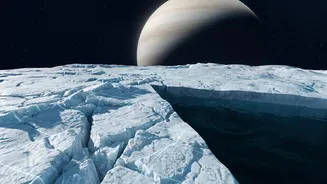
For decades, scientists have been captivated by Europa. It's a world encased in a shell of water ice that could be anywhere from a few kilometers to over 30 kilometers thick. Below this crust is a global saltwater ocean, warmed not by the distant sun,
but by the constant gravitational tug-of-war with Jupiter. This internal energy means the ocean remains liquid and could potentially host hydrothermal vents on its seafloor, similar to the vents on Earth's ocean floors that teem with life. These ingredients—water, energy, and the right chemical building blocks—make Europa one of the most promising places in our solar system to search for life beyond Earth.
Enter the Europa Clipper
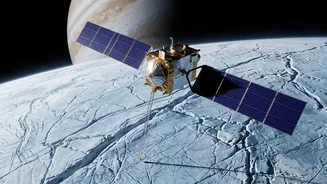
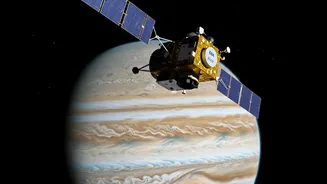
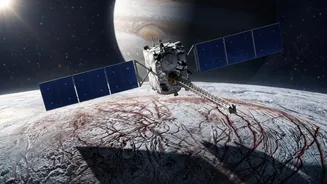
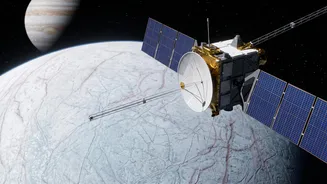
To investigate this potential, NASA launched the Europa Clipper spacecraft on October 14, 2024. This probe, the largest interplanetary spacecraft NASA has ever built, is on a multi-year journey to the Jupiter system, scheduled to arrive in April 2030. Once there, it won't orbit Europa directly, which would expose it to Jupiter's intense and damaging radiation. Instead, it will orbit Jupiter and perform nearly 50 close flybys of the icy moon, scanning almost its entire surface over four years. This strategy allows its nine advanced science instruments to gather detailed data while being protected in a radiation vault for most of its mission.
The Power of Ice-Penetrating Radar
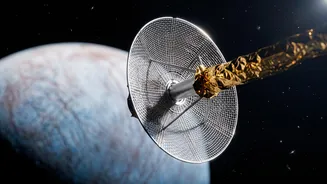
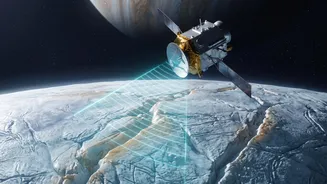
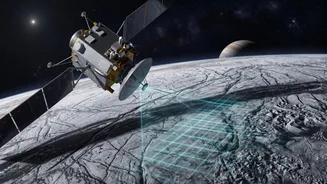
Of all the instruments aboard, one is uniquely capable of peering directly into the ice: the Radar for Europa Assessment and Sounding: Ocean to Near-surface, or REASON. Developed with technology originally used to study Antarctica's ice sheets, REASON is an ice-penetrating radar system. It works by sending out radio waves at two different frequencies (9 MHz and 60 MHz) from its large antennas. These radio waves travel through the ice but reflect back when they hit a boundary between different materials—like the critical transition from solid ice to liquid water. By measuring the time it takes for these signals to return, scientists can map the internal structure of the ice shell in three dimensions.
Searching for Pockets of Water
The primary goal of the REASON instrument is not just to confirm the existence of the main ocean, but to search for something even more tantalizing: pockets of liquid water, or brine, trapped within the ice shell itself. These shallower subsurface lakes are considered prime targets for habitability. They could act as a crucial link, allowing chemical compounds created by radiation on Europa's surface to mix with the water below. Without such a pathway, the deep ocean might lack the necessary ingredients for life to emerge. By identifying where the ice is thinnest or where these water pockets are closest to the surface, REASON can pinpoint the most geologically active and potentially life-supporting regions.
From Radar Scans to Habitability Clues
It's important to note that Europa Clipper is not a life-detection mission; it's a reconnaissance mission designed to assess habitability. The data from REASON is crucial for this task. It will provide the first direct measurements of the ice shell's thickness and structure, helping to test hypotheses about how the moon's geology works. Some recent studies have suggested Europa's seafloor might be geologically quiet, which could make it less hospitable to life. REASON’s scans will provide concrete data to help settle this debate by revealing whether the ice shell is a dynamic system of exchange or a solid, lifeless barrier. This detailed mapping will essentially create a guide for future missions, highlighting the most promising locations where a lander could one day touch down to directly search for signs of life.