




First Off, What Is a Quasar?
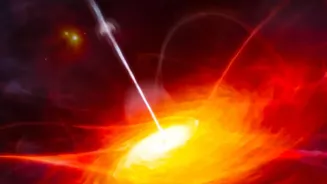
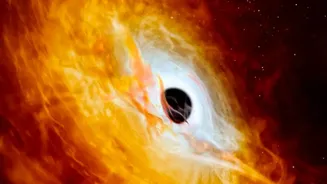
Imagine the brightest lighthouse you can think of, one that can outshine an entire galaxy of billions of stars. That’s a quasar. The name is short for ‘quasi-stellar radio source’, a nod to when they were first discovered in the 1950s and appeared star-like
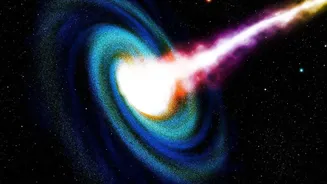
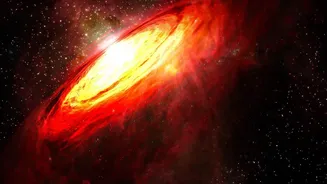
but were emitting powerful radio waves. We now know that a quasar isn't a star at all. It's the intensely luminous core of a galaxy where a supermassive black hole is actively feasting. As immense amounts of gas and dust spiral into the black hole, the material forms a superheated accretion disk. The friction and gravitational forces in this disk are so extreme that they release unimaginable amounts of energy, creating a beacon of light that can be seen across billions of light-years.
A Glimpse into the Cosmic Dawn
The finite speed of light means that when we look at distant objects, we are also looking back in time. A discovery from billions of light-years away shows us the universe as it was billions of years ago. This particular quasar pair, officially named J1602+4228AB but nicknamed Nāpōwawāʻenakaulua, was observed as it existed just 900 million years after the Big Bang. This period is known as the ‘cosmic dawn’, a time when the very first stars, galaxies, and black holes were forming. Finding any quasar this early is significant, as it provides a direct line of sight into the processes that shaped the universe. Finding two, side-by-side, offers an unprecedented laboratory for understanding how the largest cosmic structures came to be.
The Significance of a Pair
While astronomers have found other quasars from this early epoch, finding a pair is exceptionally rare and important. Current theories suggest that the most massive galaxies form through mergers. When two galaxies collide, their gravitational interactions can funnel huge amounts of gas toward their respective central black holes, igniting them both as quasars. This discovery, therefore, is thought to be a snapshot of two galaxies in the chaotic process of merging. The two quasars are separated by about 18,100 light-years—a distance that is roughly one-fifth the diameter of our own Milky Way galaxy. This makes it the most compact quasar pair ever found from this era, a direct piece of evidence for a galactic merger in progress.
A Challenge to Cosmic Timelines
Here's the puzzle that has scientists so intrigued: the black holes powering these quasars are enormous. One is estimated to have a mass of 1.5 billion times that of our sun, while its companion is around 400 million solar masses. According to our current models of the universe, it should not be possible for black holes to grow this massive, this quickly. As Dr. Silvia Onorato of NSF’s NOIRLab put it, “There is no definitive theoretical explanation for how a single one of these giant quasars exists so early in the age of our Universe, much less two.” Finding a single one is a challenge to our theories of black hole formation, but finding a pair this large and this close together suggests that the processes of galaxy and black hole growth in the early universe might have been far more rapid and dramatic than previously believed.
What This Discovery Means for Science
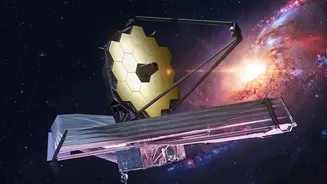
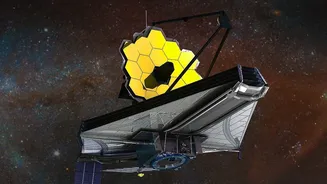
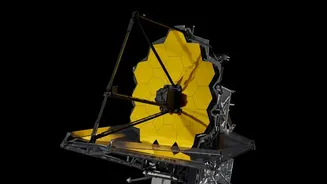
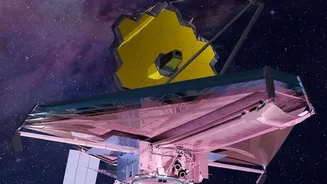
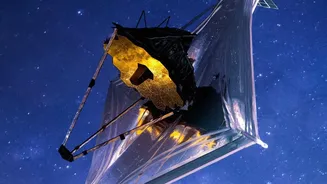
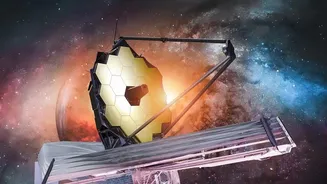
This quasar pair, discovered using data from the JWST's Aether survey and confirmed with the Gemini North telescope in Hawaiʻi, acts as a signpost. Researchers believe it likely points to an area in the early universe that was exceptionally dense with matter, creating a perfect storm for rapid galaxy interactions, intense star formation, and accelerated black hole growth. The discovery provides a crucial data point against which to test cosmological simulations of the early universe. For years, galaxy mergers have been the leading theory for how quasars are ignited, and observing this pair provides some of the strongest evidence to date for that theory in action at such an early time. It is a vivid confirmation that the cosmic dawn was a violent, chaotic, and incredibly formative period in our universe's history.