



A Planet-Sized Radio Dish
The name 'Square Kilometre Array' is both literal and figurative. It isn't a single, continuous dish, but a global effort to build the world's largest radio telescope. The project combines thousands of antennas across two continents to create a collective
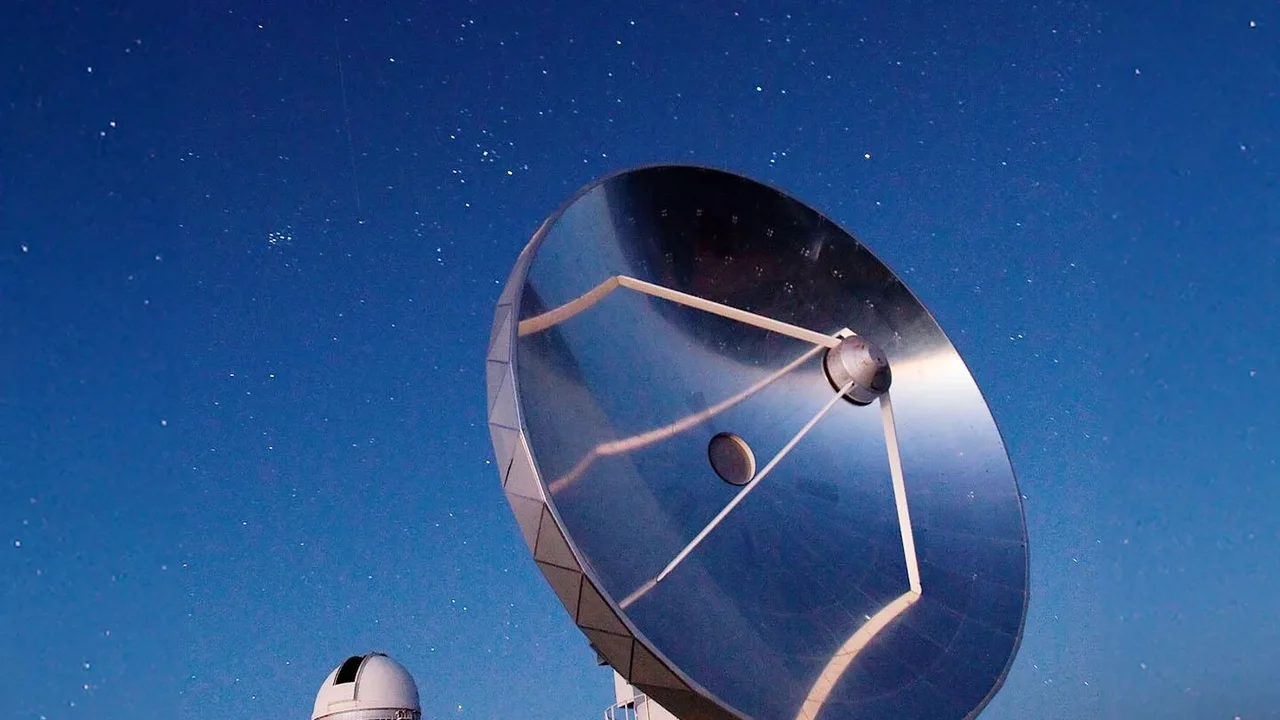
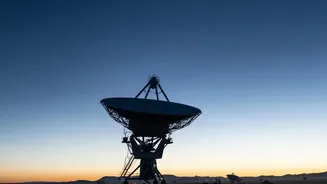
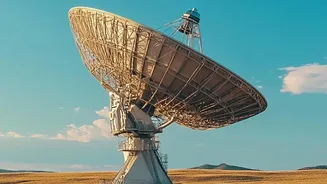
listening area of one square kilometre. This immense scale is crucial for sensitivity—the ability to detect incredibly faint radio signals that have travelled for over 13 billion years. The network is split into two main sites chosen for their remoteness and minimal radio interference: SKA-Low in Western Australia and SKA-Mid in South Africa. The Australian site will feature over 131,000 Christmas tree-like antennas, while South Africa will host nearly 200 traditional dish antennas. By linking these antennas together using a technique called interferometry, astronomers can create a single, virtual telescope with unparalleled resolution and power.
The Art of Listening
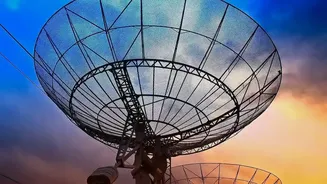
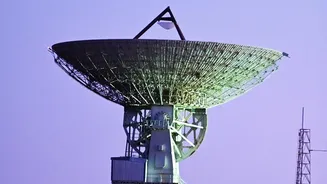
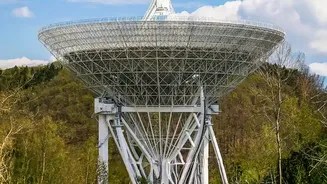
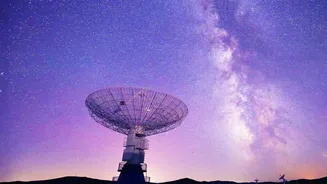
Unlike optical telescopes that see visible light, the SKA listens for radio waves. The antennas—whether the 'Christmas trees' of SKA-Low or the dishes of SKA-Mid—are designed to capture these cosmic signals. In Australia, the low-frequency antennas are tuned to detect signals from the universe's infancy, which have been stretched to longer wavelengths by the expansion of the cosmos. In South Africa, the mid-frequency dishes will focus on a different range of signals, studying everything from pulsars to the formation of galaxies. The signals from each individual antenna are digitised and sent via fibre optic cables to powerful supercomputers. These central processors correlate the data, combining the signals in real-time to function as one giant telescope. This 'mathematical' telescope can even be digitally 'pointed' at different parts of the sky without physically moving the antennas, allowing it to survey vast areas with incredible speed.
Tuning into the Cosmic Dawn
One of the SKA's primary missions is to peer back into a mysterious era known as the 'Cosmic Dawn' and the subsequent 'Epoch of Reionization'. This was the period, in the first billion years after the Big Bang, when the very first stars and galaxies lit up the universe. Before this, the cosmos was filled with a fog of neutral hydrogen gas. The SKA is specifically designed to detect the faint, 21-centimetre signal emitted by this primordial hydrogen. By mapping how this signal changed as the first stars ignited and their radiation ionized the surrounding gas, scientists can create a 3D picture of the early universe. This will help answer fundamental questions about how the first celestial structures formed and evolved.
India's Role in the Cosmic Quest
India has been a pivotal partner in the SKA project from its early stages, with the National Centre for Radio Astrophysics (NCRA) in Pune coordinating the country's efforts. A significant Indian contribution has been leading the design and development of the Telescope Manager, the sophisticated software system that acts as the 'neural network' or central control for the entire observatory. With a financial commitment of ₹1,250 crore, India is a full member of the SKA Organisation, participating in the ongoing construction phase. This involvement extends to developing digital signal processing hardware for the SKA-Low telescope and contributing to data processing software. This partnership not only leverages the expertise from facilities like India's own Giant Metrewave Radio Telescope (GMRT) but also ensures the Indian scientific community will have a key role in the groundbreaking discoveries to come.