



First, Check Your Source
The internet is flooded with amazing space pictures, but not all are what they seem. The first step before getting too excited is to verify the source. Official images from the James Webb Space Telescope are released by NASA, the European Space Agency
(ESA), and the Canadian Space Agency (CSA). Their websites, along with the Space Telescope Science Institute (STScI), are the primary sources for authentic images and data. If you see a breathtaking new image on social media or a news aggregator, a quick search for the official release is a good habit. This ensures you're looking at a real observation and not a digital artist's creation, a common misunderstanding. Official sources will always clarify if an image is an observation or an artist's impression.
Understand the Truth About ‘False Color’
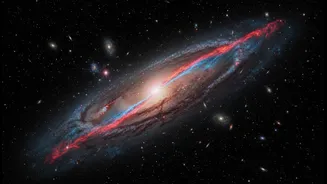
Many of Webb’s most stunning images are presented in 'false color'. This doesn't mean they are fake. The JWST observes in infrared light, which is invisible to the human eye. To make the data visible, scientists assign colors like red, green, and blue to different infrared wavelengths. Typically, the longest wavelength is assigned red and the shortest is assigned blue. This process is a form of data translation. It allows us to see features that would otherwise be hidden and helps astronomers highlight specific elements, like clouds of hydrogen or dust. The incredible new image of Centaurus A, for instance, uses multiple infrared filters from Webb's NIRCam and MIRI instruments to reveal the galaxy's dusty structure and millions of individual stars, something impossible in visible light. The colors aren't what you'd see with your eyes, but they tell a true scientific story.
Is it a Photo, a Composite, or Art?
Not every image released is a single snapshot. Many are 'composite' images, created by combining data from different observations or even different telescopes. For example, the new Centaurus A release features views from both Webb's Near-Infrared Camera (NIRCam) and its Mid-Infrared Instrument (MIRI). Combining them reveals different aspects of the galaxy—NIRCam shows fields of stars, while MIRI highlights the glowing dust. It’s also crucial to distinguish between an actual image and an 'artist's impression'. When we don't have a direct photo, like with distant exoplanets, artists use scientific data to create an educated guess of what it might look like. Reputable sources are always clear about this distinction, so reading the caption is key. The Centaurus A image is a true observation, but the principle is important for all space news.
Read the Story Behind the Image
An image from Webb is more than just a pretty picture; it's a piece of a scientific puzzle. The press releases and articles accompanying new images are treasure troves of context. They explain why astronomers chose to observe this particular object and what new information the image provides. For Centaurus A, Webb's image is a form of 'galactic archaeology'. This galaxy is the result of a massive collision between two galaxies billions of years ago. Webb's power to cut through the thick dust lanes that obscure the galaxy's center allows scientists to see the aftermath of this merger in unprecedented detail. By resolving millions of individual stars, astronomers can build a timeline of the galaxy's violent history and study the workings of the supermassive black hole at its core.
Appreciate What’s New and What’s Next
The new Webb image of Centaurus A is significant because it builds upon decades of previous observations. Telescopes like Hubble (visible light) and Spitzer (infrared) studied Centaurus A, but lacked the power to resolve individual stars through its dense dust. Webb’s superior sensitivity and infrared capabilities provide a much clearer and deeper view. This allows astronomers to tackle big questions, like how the galaxy's central black hole influences star formation around it. The images also reveal new mysteries, such as a curious 'S' shaped feature that scientists don't yet understand. Each new image from Webb isn't just an endpoint; it's a starting point for years of further research and discovery, building a more complete picture of how our universe evolves.