


First, What Is a Solar Storm?
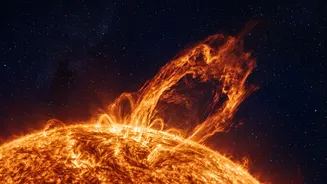
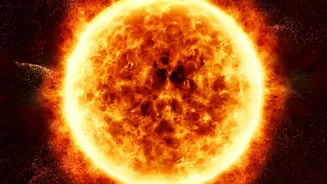
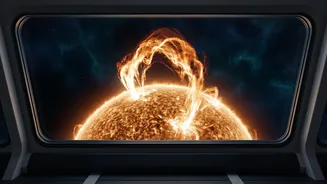
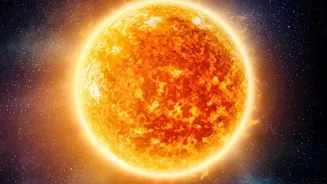
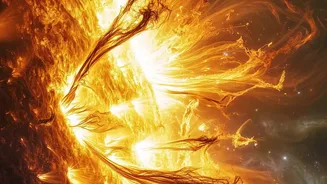
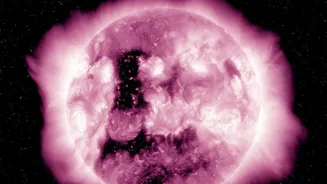
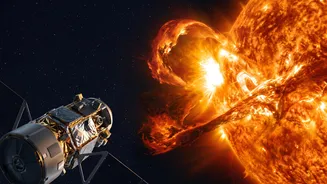
Think of a solar storm as a massive, energetic outburst from the Sun. These events can happen in a couple of ways. Sometimes, the Sun's magnetic fields get tangled and snap like a rubber band, releasing an intense burst of light and energy called a solar flare.
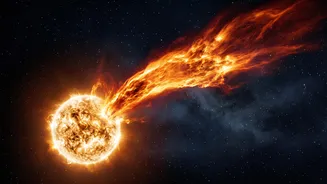
Other times, the Sun ejects a huge cloud of magnetised plasma into space, known as a coronal mass ejection (CME). When these powerful blasts of energy and particles are aimed at Earth, they can cause a significant disturbance in our planet's magnetic field, creating what scientists call a geomagnetic storm.
Why Are These Storms a Danger?
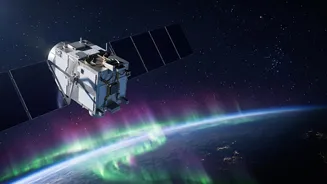
While solar storms pose no direct danger to humans on the ground, they are a major threat to the technology that powers our modern world. A strong geomagnetic storm can induce extra electrical currents in power grids, potentially leading to widespread blackouts that could last for hours or even longer. They can also disrupt high-frequency radio communications and scramble the GPS signals that we rely on for navigation in everything from cars to airplanes. Furthermore, the intense radiation can damage the sensitive electronics of satellites in orbit, affecting everything from weather forecasting to internet services.
The Challenge of Predicting Space Weather
Predicting exactly when and where a solar storm will impact Earth has always been incredibly challenging. For a long time, scientists have monitored the Sun for clues like sunspots and solar flares. However, even when a massive eruption is spotted, knowing if it will hit Earth and how severe its effects will be has been difficult. Previous forecasting models that used AI could only provide forecasts for specific local areas, while global prediction models were often not timely enough to be truly useful for preventing damage.
Enter DAGGER: NASA's AI Game-Changer
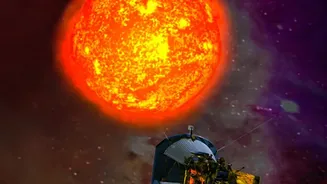
This is where NASA's new research comes in. An international team of researchers has developed an AI-powered model called DAGGER, which stands for Deep Learning Geomagnetic Perturbation. This system represents a massive leap forward. By combining AI with real-time data from NASA satellites that monitor the solar wind—the constant stream of particles from the Sun—DAGGER can predict the specific location and intensity of a geomagnetic disturbance anywhere on Earth with a 30-minute advance warning.
How Does This AI Actually Work?
The secret behind DAGGER is a process called 'deep learning'. Researchers fed the AI vast amounts of historical data from solar wind missions and ground-based observatories. The AI learned to recognise the complex patterns and relationships between the solar wind measurements and the resulting geomagnetic storms on Earth. Now, it can analyse live satellite data and, in less than a second, generate an accurate forecast that updates every single minute. It's like a weather forecaster that has studied every storm in history to predict the next one with incredible speed and precision.
What a 30-Minute Warning Means For Us
Thirty minutes might not sound like much, but in the world of space weather, it's a critical window of opportunity. This advance warning gives power grid operators time to take preventative measures to protect their systems from damaging electrical surges. Satellite controllers can prepare their spacecraft for the incoming radiation, and telecommunication companies can brace for potential disruptions. This ability to act, rather than just react, can help prevent the kind of technological chaos that a severe solar storm could cause, safeguarding economies and livelihoods.