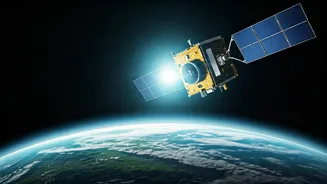









The Invisible Landfill Above Us
Out of sight, out of mind. That’s been our collective attitude towards the space above our heads. We launch satellites for communication, GPS for navigation, and telescopes to peer into the universe's past. But every launch leaves something behind. For
over 60 years, we have been populating Earth's orbits not just with active satellites, but with a growing cloud of junk: defunct satellites, spent rocket stages, and fragments from collisions and explosions. This is orbital debris, or 'space junk'. According to the European Space Agency (ESA), there are an estimated 36,500 objects larger than 10 cm circling our planet. Add to that millions of smaller, untrackable pieces of shrapnel, each travelling at speeds of over 28,000 km/h. At that velocity, even a paint chip can cause catastrophic damage to a functional satellite or a crewed spacecraft. This creates a terrifying feedback loop known as the Kessler Syndrome, where one collision creates more debris, leading to more collisions. We are on the verge of making near-Earth orbit an unusable, treacherous minefield, threatening the very infrastructure—from weather forecasting to online banking—that modern society depends on.
Enter The Celestial Janitor
This is where the story shifts from a looming crisis to one of pioneering innovation. In 2026, the world will be watching a mission that looks less like exploration and more like an environmental clean-up. Commissioned by the ESA and developed by Swiss startup ClearSpace, the ClearSpace-1 mission is set to be the first of its kind: an active debris removal (ADR) mission. Its goal is not to visit a new planet, but to hunt down and remove a single piece of space junk.
The target is a 112 kg object called a Vespa (VEga Secondary Payload Adapter), which was left in a 'disposal orbit' after a rocket launch in 2013. While harmless for now, it serves as the perfect test subject for a technology that could one day form the backbone of a new, sustainable space economy. The mission is simple in concept but incredibly complex in execution: launch a chaser satellite, rendezvous with the target, capture it, and then perform a controlled re-entry where both the chaser and the debris burn up safely in Earth’s atmosphere.
A High-Stakes Claw Game
So how does it work? Imagine playing a claw game, but your prize is tumbling uncontrollably thousands of kilometres away and travelling 20 times faster than a bullet. The ClearSpace-1 chaser is a marvel of engineering, equipped with a set of four robotic arms designed to embrace the Vespa. First, the chaser will be launched into a lower orbit before gradually raising its altitude to match that of the Vespa. Then begins the delicate dance of approach and synchronisation.
Using advanced AI-powered sensors and navigation cameras, the chaser will autonomously observe the Vespa, learning its spin and trajectory. Once it has a perfect lock, it will move in for the capture, closing its arms around the junk. After a secure capture, the combined spacecraft will perform a final engine burn to de-orbit, ensuring it disintegrates over a safe, uninhabited area like the South Pacific Ocean. Every step is fraught with risk, but success would prove that we have the tools to begin tidying up our orbital backyard.
The New Face of Sustainability
Why is a space clean-up mission being hailed as a sustainability story? Because it reframes our relationship with the environment beyond Earth's atmosphere. Sustainability is about ensuring that the needs of the present don't compromise the ability of future generations to meet their own. By treating orbit as a finite resource that needs protection, we are applying this core principle to space.
For a space-faring nation like India, this is especially relevant. ISRO’s ambitious programmes, from communications satellites to the Gaganyaan human spaceflight mission, rely on safe and accessible orbits. Initiatives like ISRO's Project NETRA (Network for space object Tracking and Analysis) show a growing awareness of the debris threat. The success of ClearSpace-1 will not only validate the technology but also pave the way for a commercial market in orbital services. This includes satellite repair, refuelling, and, most importantly, debris removal—creating a circular economy in space and safeguarding crucial assets for all nations.