




The Imaginary Bedrock of Reality?
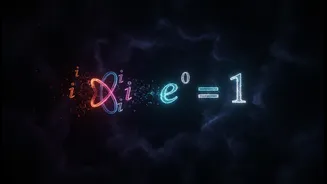
Quantum mechanics, the theory that governs the bizarre world of atoms and particles, is built on a mathematical foundation that includes complex numbers. These aren't just the 'real' numbers we use for everyday counting and measuring; a complex number has
a real part and an 'imaginary' part, which is a multiple of the square root of -1, famously represented by the symbol 'i'. While they might sound abstract, these numbers are everywhere in the equations that describe the quantum world, most notably Erwin Schrödinger's famous wave equation. For decades, physicists have used them to describe fundamental quantum properties, from the wavelike nature of particles to the phenomenon of entanglement. The question has always lingered, however: Is 'i' truly a fundamental part of nature, or just a convenient shortcut for our calculations?
A Century-Old Assumption
The debate is almost as old as the theory itself. Even Schrödinger, one of its pioneers, was puzzled by the appearance of complex numbers in his work. In classical physics, like describing the path of a thrown ball, real numbers are all you need. But quantum mechanics is different. Complex numbers became indispensable because they elegantly handle concepts like wave phase and interference, which are central to how quantum systems evolve. Most physicists accepted them as a core feature, believing that a version of quantum theory using only real numbers would be incomplete. For a long time, this was more of a philosophical debate than a scientific one, as there was no clear way to test it. It was widely assumed that removing 'i' would break the theory's predictive power.
Putting Reality to the Test
The game changed when physicists devised clever experiments to put the question to a direct test. Inspired by a famous type of experiment known as a Bell test, which probes the fundamental nature of quantum reality, teams of scientists set up scenarios to check if a 'real-number-only' quantum theory could explain what they saw. In 2021, a landmark paper argued that a specific experiment involving entangled particles in a network could definitively prove whether complex numbers were necessary. The experiments were then carried out by independent teams. The results were striking: the predictions made by the standard, complex-number version of quantum theory matched the experimental data, while the predictions from a restricted real-number version did not. It seemed the case was closed: quantum mechanics needed its imaginary part.
A New Twist in the Tale
However, science loves a good plot twist. Very recently, as of July 2026, a new study has challenged that conclusion. Researchers took a closer look at the assumptions made in the earlier experiments. They argued that those tests relied on a specific mathematical rule for combining quantum systems that was too restrictive. A team from Heinrich Heine University Düsseldorf and the German Aerospace Center developed a new formulation. By treating quantum systems in a slightly different but physically motivated way, they constructed a complete version of quantum mechanics using only real numbers that makes all the same predictions as the standard complex-number version. Essentially, they found a way to account for the information usually stored in the imaginary part by using a clever labeling system with only real numbers. As study author Pedro Barrios Hita stated, this new model suggests complex numbers are not strictly needed.
So, Are They Needed or Not?
This latest development has reignited the century-old debate. It shows that whether you 'need' complex numbers depends on the specific rules you assume for your theory. The 2021-2022 experiments convincingly showed that a simple real-number theory fails. But the 2026 research demonstrates that a more sophisticated real-number theory can succeed. What does this mean in practice? Most physicists will likely continue using complex numbers because the equations are far simpler and more elegant that way. As one physicist noted, even the new real-number theories still have to simulate the behavior of complex numbers in a more roundabout way. However, settling this foundational question is crucial. It forces a deeper understanding of the core principles of quantum mechanics and rules out certain philosophical interpretations of the theory, clarifying what is truly essential to describe our universe.