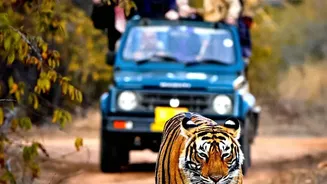






India's triumphant tiger population growth is a world-renowned conservation success. But with over 3,600 tigers, many parks are at capacity, creating new challenges. How does India plan to manage this success? Enter a bold two-pronged strategy.
A Success Story's New Chapter
Thanks
to decades of concerted efforts under Project Tiger, launched in 1973, India is home to roughly 75% of the world's wild tigers. The latest census from 2022 revealed an estimated 3,682 tigers, more than double the number from 2006. This remarkable comeback, from a low of around 1,800 in the 1970s, has shifted the focus of conservation. The primary challenge is no longer just about preventing extinction but managing a thriving population in a rapidly developing nation. With many of the 58 tiger reserves nearing full capacity, young tigers are dispersing outside protected areas to find their own territories. Experts estimate that over a third of India's tigers now live in human-dominated landscapes, leading to increased human-wildlife conflict and new pressures on the animals and the communities living alongside them.
The Twin Pillars: Relocation and Corridors
To address this complex issue, conservation authorities, led by the National Tiger Conservation Authority (NTCA), are employing a dual strategy: tiger translocation and the development of wildlife corridors. Translocation involves the scientific and carefully planned relocation of tigers. This can mean moving them from high-density reserves to areas where their numbers are low or have been wiped out, as was famously done in Rajasthan's Sariska Tiger Reserve and Madhya Pradesh's Panna Tiger Reserve. The second, equally crucial part of the strategy is securing 'tiger corridors'. These are natural pathways that allow tigers to move between larger forest patches and reserves. These corridors are essential for maintaining genetic diversity by preventing populations from becoming isolated and for providing dispersing tigers with safe passage.
The Science of Moving a Tiger
Relocating a tiger is a delicate and high-stakes operation managed by wildlife experts from the NTCA and the Wildlife Institute of India (WII). The process begins with identifying a suitable candidate—often a young, dispersing individual. The animal is tranquilised, given a thorough health check, and fitted with a radio collar for post-release monitoring. The success of a translocation hinges on a suitable new home with an adequate prey base and minimal human disturbance. The stories from Sariska and Panna, both of which lost all their tigers to poaching, stand as powerful testaments to the potential of this strategy. After being repopulated through translocation starting in 2009, Panna's tiger count has grown impressively, demonstrating that with careful management, tiger populations can be successfully re-established.
Building Bridges for Big Cats
A tiger corridor is more than just a strip of trees. It is a functional landscape that must accommodate both wildlife and people. The biggest threat to these corridors is habitat fragmentation caused by infrastructure projects like highways, railway lines, and canals. In response, India has become a leader in constructing wildlife mitigation structures, including underpasses and overpasses designed to let animals cross safely. However, legal protection for these corridors is not as strong as for official reserves, making them vulnerable to encroachment and degradation. Conservation organisations work with local communities, known as 'Green Corridor Champions', to patrol these areas, manage conflict, and ensure the pathways remain viable for tigers and other wildlife.
Navigating the Human Landscape
Ultimately, the long-term success of both relocation and corridors depends on people. Managing human-tiger conflict is one of the most significant challenges. When tigers stray into villages or prey on livestock, it can lead to retaliatory killings. To foster coexistence, strategies include timely compensation for livestock losses, community-led initiatives to reduce forest dependency, and the use of technology like AI-powered cameras to send early warnings when a tiger is near a village. Engaging local communities as partners in conservation, rather than viewing them as obstacles, is increasingly seen as the key. By providing alternative livelihoods and ensuring they see the benefits of conservation, authorities hope to create a landscape where both people and tigers can thrive.