



A Celestial Case of Mistaken Identity
For decades, our understanding of the solar system was tidy: asteroids are inert rocks, and comets are icy bodies that flare up with tails near the sun. Asteroids mostly live in the main belt between Mars and Jupiter, while comets are visitors from the frigid
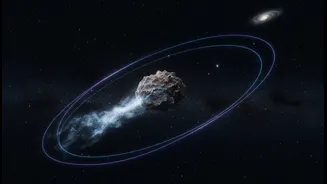
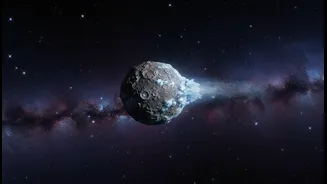
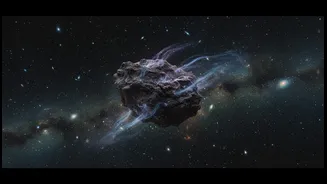
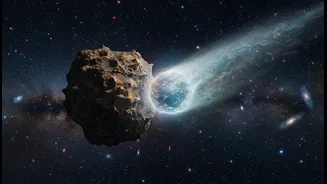
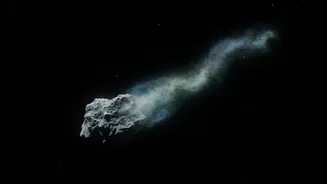
outer reaches. But a new class of objects is challenging these clear-cut categories. Known as 'active asteroids' or 'main-belt comets,' these bodies have the orbit of an asteroid but exhibit the characteristics of a comet, such as a dusty tail. A prime example is an object named (248370) 2005 QN173. For years, it was just another dot in the asteroid belt. Then, in 2021, astronomers using the Asteroid Terrestrial-impact Last Alert System (ATLAS) noticed something astonishing: it had grown a long, narrow tail. This discovery turned a supposedly boring rock into a fascinating scientific puzzle.
Clue 1: The Orbital Telltale
The first step in any celestial investigation is to examine the object's path. An object's orbit is its fingerprint, revealing its origins. Comets typically have highly eccentric, or elongated, orbits that take them from the distant, cold Kuiper Belt or Oort Cloud into the inner solar system and back out again. Asteroids, by contrast, tend to have more circular orbits that keep them neatly within the main asteroid belt. 2005 QN173 has a classic asteroid orbit—it stays within the outer part of the main belt, never venturing much farther out than Jupiter. Its path is stable and predictable, unlike a typical comet's wild journey. This is the central mystery: why is an object with an asteroid's address behaving like a comet? The orbit strongly suggests it formed in the inner solar system, not the icy depths where most comets are born.
Clue 2: Decoding the Tail
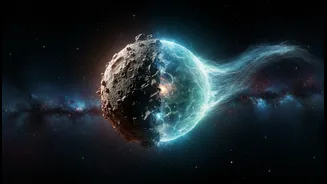
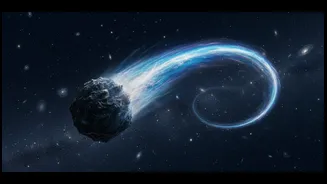
The most dramatic piece of evidence is, of course, the tail. A comet's tail is formed when solar radiation heats its surface, causing ices to turn directly into gas in a process called sublimation. This process spews dust and gas, which are then pushed away by solar wind and radiation pressure, forming the characteristic tail. But tails can be created by other means. Asteroids can get them if they are hit by another object, kicking up a cloud of debris, or if they spin so fast that material flies off their surface. To determine the cause, scientists study the tail's shape and behavior over time. For 2005 QN173, archival images revealed it also had a tail during a previous approach to the sun in 2016. This recurrent activity is a smoking gun. A one-time collision would not create a tail on a predictable schedule. This repeating performance strongly indicates that the activity is driven by the sublimation of hidden ice, just like a comet.
Clue 3: The Hunt for Hidden Volatiles
The final clue lies in the object's composition. 'Volatiles' are substances like water ice that vaporize at relatively low temperatures. Traditional comets are packed with them. Asteroids, having formed closer to the sun, are generally thought to be rocky and depleted of these ices. Finding evidence of volatiles on an object with an asteroid's orbit is a groundbreaking discovery. The repeated activity of 2005 QN173 near its closest approach to the sun (its perihelion) is the key indicator that it contains sublimating ice. Though the ice itself isn't seen directly, its effect—the creation of a tail—is unmistakable. This suggests that some asteroids in the main belt may have preserved pockets of subsurface ice for billions of years, which are exposed by small impacts or other processes. This changes how we see the asteroid belt, transforming it from a dry, rocky graveyard into a region that might harbor hidden reserves of water ice.