




The Problem with 'Fast Furniture'
Much of the affordable, ready-to-assemble furniture on the market is designed for one-time assembly, not a life in motion. These pieces often rely on materials like particleboard or low-density fibreboard, which are cost-effective but structurally fragile.
The real point of failure, however, is the joinery. Simple screws driven directly into particleboard, flimsy cam locks, and staples are quick to produce but create weak connections. When you disassemble and reassemble furniture held together this way, the screw holes widen, the particleboard crumbles, and the hardware no longer fits snugly. The result is a wobbly table or a sagging bookshelf that often gets discarded, contributing to waste and costing you money over time.
The Heroes: Knock-Down Fasteners
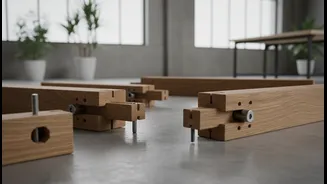
Furniture designed for repeated moves uses a category of hardware known as “knock-down fasteners.” These are mechanical connectors engineered for easy assembly and disassembly without sacrificing strength. Instead of a simple screw in particleboard, look for pieces that use metal-on-metal connections. Common examples include cross-dowels (or barrel nuts) and connector bolts, which create a powerful joint that can be tightened and loosened many times. Another type is a threaded insert—a metal sleeve placed within the wood to provide durable machine threads for a bolt. This prevents the wood itself from stripping. Quality bed frames, for instance, often use heavy-duty knock-down bolts to connect the rails to the headboard and footboard, allowing them to be moved without damage.
Traditional Joinery That Can Travel
While many traditional woodworking joints like dovetails and mortise-and-tenons are hallmarks of quality, they are often glued for permanence. However, some traditional methods are inherently designed for disassembly. The tusk tenon is a classic example. It involves a tenon (a projecting piece of wood) that passes completely through a mortise (a hole) and is secured on the other side with a removable wedge. This creates an incredibly strong, visually appealing joint that can be taken apart with a simple tap on the wedge. Similarly, some high-end pieces use unglued, pinned mortise-and-tenon joints or sliding dovetails that allow parts to be separated for transport. These methods combine timeless craftsmanship with modern practicality.
Joints to Avoid for a Life on the Move
When shopping for furniture that needs to last through several moves, there are red flags to watch for. The most significant is a heavy reliance on staples, nails, or visible glue as the primary method of holding structural parts together. These are signs of low-cost manufacturing and are almost guaranteed to fail under the stress of a move. Be wary of furniture where screws are driven directly into the cut edge or face of particleboard without any reinforcement. Also, inspect drawer construction. While dovetail joints are a sign of high quality, many cheaper dressers use drawers that are simply stapled or pinned together. These are likely to rack and fall apart with repeated use and movement.
How to Be a Smarter Furniture Shopper
You don't need to be a woodworker to spot good joinery. When you're in a showroom, give the furniture a gentle shake; it shouldn't wobble or creak. Open drawers and look at the corners to see how they are joined. Are they interlocked (like a dovetail) or just stapled? Ask the salesperson how the piece is assembled. If it's a flat-pack item, inquire about the type of fasteners used. Look for terms like "metal-to-metal connections," "connector bolts," or "threaded inserts." For tables and chairs, check how the legs are attached to the frame; bolted connections are far superior to those held on by a few screws. A piece built for longevity will feel solid and stable, even before it's in your home.