



The Challenge of Weight in Space
For decades, launching a satellite into orbit followed a simple, if brute-force, principle. A satellite needed to carry not just its own operational equipment—like transponders and sensors—but also a massive amount of chemical propellant. This fuel is essential
for the journey to its final orbit and for making small adjustments, known as station-keeping, throughout its life. This traditional chemical propulsion works by burning fuel and an oxidizer to create a powerful, high-thrust explosion, pushing the satellite forward. While effective for providing a strong push, it’s incredibly inefficient. The propellant itself is heavy, and a significant portion of a satellite’s total launch mass is just fuel. This creates a fundamental problem: the heavier the fuel load, the less weight is available for the actual payload that performs the mission. It also makes the entire satellite heavier, requiring a more powerful and expensive rocket to lift it from Earth.
Enter Electric Propulsion: A Gentle, Efficient Push
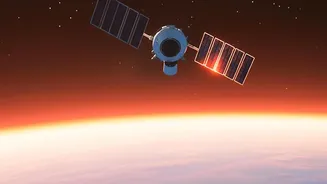
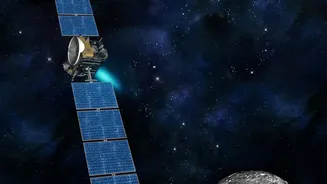
Electric propulsion (EP) systems work on a completely different principle. Instead of a violent chemical reaction, they use electrical power, typically generated by the satellite’s solar panels, to create electric and magnetic fields. These fields accelerate a small amount of inert gas propellant, like xenon, ejecting charged particles (ions) at extremely high speeds. This process generates thrust. The key difference is the trade-off between thrust and efficiency. While a chemical rocket provides a powerful, short burst of thrust, an electric thruster provides a very gentle, low-thrust push—sometimes compared to the force of a single sheet of paper resting on your hand. However, it can maintain this push continuously for months or even years. The result is a system that is vastly more fuel-efficient. Electric propulsion can be up to 10 times more efficient than chemical systems, a metric measured by 'specific impulse'.
Cutting Weight, Boosting Payload
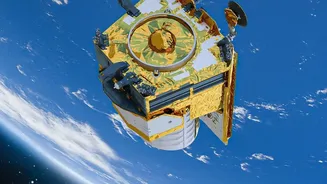
This incredible fuel efficiency is how electric propulsion directly cuts launch weight. Because so little propellant is needed, the fuel tanks on the satellite can be drastically smaller and lighter. For a typical 5,000 kg communication satellite using chemical propulsion, the fuel alone can account for a huge portion of its mass. By switching to an all-electric system, ISRO can significantly reduce the satellite's total mass. This weight saving creates two powerful advantages. First, the saved mass can be reallocated to the payload. This means a satellite of the same weight can carry more transponders, more powerful antennas, or more advanced scientific instruments, increasing its functional capacity and commercial value. Second, a lighter satellite can be launched on a less powerful, and therefore cheaper, rocket, leading to significant cost savings on the launch itself.
Longer Life in Orbit
A satellite's operational lifespan is often determined by how long its station-keeping fuel lasts. Once it runs out of fuel to make orbital corrections, it starts to drift and becomes unusable. Because electric propulsion is so efficient, a satellite can perform these essential manoeuvres for a much longer period. A satellite that might have had a 12-year lifespan with chemical thrusters could potentially operate for 15 to 20 years with an electric system. This extended operational life is a massive boon for satellite operators, including ISRO. It means a single satellite can generate revenue or provide strategic services for several additional years, dramatically improving the return on investment for each mission and ensuring India maintains its presence in key orbital slots for longer.
ISRO's Leap into Electric-First Satellites
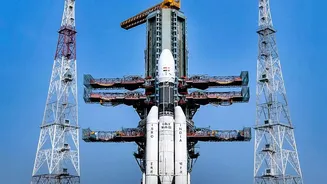
ISRO has been strategically moving towards this technology. While it has used imported electric thrusters on satellites like GSAT-9 for station-keeping, the space agency has been developing its own indigenous systems. A major milestone is the planned launch of the Technology Demonstrator Satellite (TDS-01), which is set to feature a fully Indian-made electric propulsion system for both orbit raising and in-orbit manoeuvres. Furthermore, upcoming heavy communication satellites like GSAT-20 (also known as GSAT-N2) are being designed to leverage these advancements. Initially, some heavy satellites required foreign launchers like SpaceX's Falcon 9 due to their mass. However, by perfecting electric propulsion, ISRO aims to reduce the overall mass of future satellites, potentially allowing them to be launched on its own powerful rockets like the LVM3, further enhancing India’s self-reliance in space.