






Why You Must Act Quickly
Ignoring an error in your tax payment won't make it go away. In fact, delaying the correction can have significant financial consequences. The Income Tax Department's systems are designed to flag discrepancies, and a small mistake can quickly snowball.
If the error leads to a shortfall in tax paid, you could be liable for penal interest, which accrues from the date the payment was due. In some cases of misreporting or underreporting income, penalties can be severe, ranging from 50% to 200% of the tax payable on the underreported income. Beyond the financial costs, an uncorrected error can lead to a notice from the department, causing unnecessary anxiety and requiring a significant amount of time to resolve. Promptly rectifying a mistake demonstrates good faith and helps keep your tax record clean, ensuring smoother processing of future returns and refunds.
The Most Common Payment Mistakes
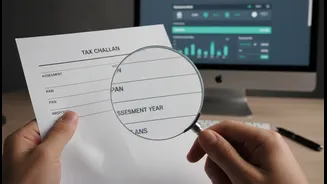
Taxpayers can make several common errors when paying their taxes, often due to a simple oversight. One of the most frequent is selecting the wrong Assessment Year (AY). For example, for income earned between April 1, 2025, and March 31, 2026 (Financial Year 2025-26), the correct Assessment Year is 2026-27. Another common slip-up is choosing the incorrect type of tax payment, known as the Minor Head. You might select 'Self-Assessment Tax' (Minor Head 300) when you meant to pay 'Advance Tax' (Minor Head 100). Errors in the Major Head (e.g., 'Corporation Tax' instead of 'Income Tax') also occur. Finally, simple data entry mistakes like entering the wrong PAN or an incorrect amount can cause significant issues, leading to payment mismatches and processing delays.
How to Correct Challan Errors Online
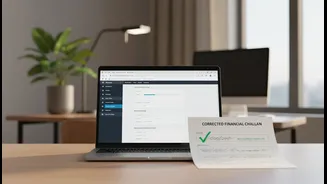
The good news is that the Income Tax e-Filing portal provides an online facility for challan correction, making the process much simpler than it used to be. This service is available for challans from Assessment Year 2020-21 onwards. To initiate a correction, log in to the e-filing portal, navigate to the 'Services' tab, and select 'Challan Correction'. You will then be able to create a correction request. The system allows you to correct the Assessment Year, Major Head, and Minor Head. After selecting the challan you wish to correct, you can input the right information, review the changes, and submit the request after e-verification via Aadhaar OTP or other available methods. It's crucial to remember that the challan must be 'unconsumed', meaning it has not yet been used against a tax liability in a filed return.
Understanding the Timelines
Time is of the essence when it comes to challan correction. The window for making changes is limited. For an incorrect Assessment Year, you have only 7 days from the date of the challan deposit to submit a correction request through the portal. For mistakes in the Major Head (tax applicable) or Minor Head (type of payment), the window is more generous, giving you 30 days from the challan deposit date. Missing these deadlines for online correction does not mean all is lost, but it complicates the process significantly.
When You Must Approach Your Assessing Officer
If you miss the online correction window or need to rectify an error that the portal does not support (such as a mistake in the PAN itself or corrections for challans prior to AY 2020-21), you must approach your Jurisdictional Assessing Officer (AO). This is an offline process that requires you to submit a formal letter detailing the error and the requested correction, along with supporting documents like a copy of the original challan and your PAN card. You can find your AO's details on the e-filing portal under the 'Know Your AO' link. While more time-consuming, this manual process is the designated path for rectifying errors that fall outside the scope of the online facility. Keep in mind that only corrections submitted through the e-filing portal are tracked online; offline corrections with the AO will not be reflected on the portal.