





A New Cosmic Ingredient
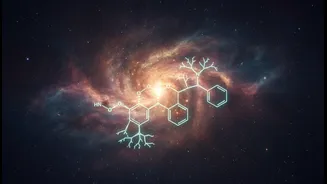
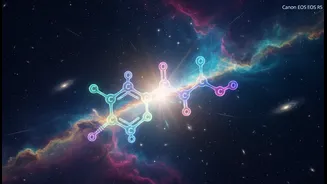
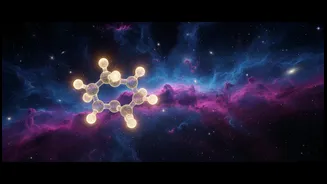
Scientists have identified a molecule named 2-methoxyethanol in a distant star-forming region. While the name is a mouthful, its significance lies in its complexity. Composed of 13 atoms (three carbon, eight hydrogen, and two oxygen), it is one of the largest
and most intricate molecules of its type ever found in interstellar space. In astronomy, any carbon-based molecule with six or more atoms is considered a Complex Organic Molecule, or COM. This discovery is notable because molecules of this size and structure are considered important precursors to the building blocks of life, like amino acids and sugars. On Earth, 2-methoxyethanol is a solvent, but in the cosmos, its presence suggests a much more interesting role.
A Stellar Nursery Far, Far Away
The molecule was found in a region known as NGC 6334I, a sprawling stellar nursery sometimes called the Cat's Paw Nebula. This isn't just a random point in the sky; it's a dynamic environment where new stars and planetary systems are being born from massive clouds of gas and dust. Detecting 2-methoxyethanol here is particularly exciting because it confirms that such complex chemistry is happening very early in the process of star formation. These molecules form on the surfaces of cold dust grains and eventually get incorporated into the material that builds new planets and comets, essentially seeding them with advanced chemical ingredients from the very beginning.
The Chemical 'Barcode' in Space
Finding a specific molecule hundreds or thousands of light-years away is a remarkable feat of science. Astronomers use powerful radio telescopes like the Atacama Large Millimeter/submillimeter Array (ALMA) to do it. Every molecule, when energised, rotates and vibrates at specific frequencies. This creates a unique spectral signature, much like a barcode. Before they could find 2-methoxyethanol in space, researchers first had to precisely measure its 'barcode' in a laboratory on Earth. A machine learning model even helped suggest it would be a good target to search for. Armed with this information, astronomers scanned the data from NGC 6334I and found 25 matching signals, providing a secure detection.
Why This Discovery Matters
The detection of 2-methoxyethanol adds a crucial piece to the puzzle of astrochemistry. It supports the growing theory that the fundamental ingredients for life are not unique to Earth but are common throughout the universe. Finding such a large molecule confirms that the universe is a highly efficient chemical factory, capable of building complex structures even in the cold, harsh environment of a stellar nursery. Each discovery like this helps scientists trace the chemical pathway from simple atoms floating in space to the rich organic chemistry needed for life to emerge. It suggests that when new planets form, they may already have access to a rich inventory of complex molecules delivered by the very gas and dust from which they are born.
Shaping the Future of Space Research
This finding will directly influence the direction of future space research. It tells astronomers that large, life-relevant molecules can and do exist in these environments, giving them a better idea of what to look for and where. Telescopes like the James Webb Space Telescope (JWST) can now be used to conduct even more sensitive searches for this molecule and others like it in different star-forming regions. The discovery helps refine scientific models of how stars and planets form, incorporating a more complex and realistic understanding of the chemistry involved. It strengthens the case for studying comets and asteroids within our own solar system, as they are thought to be pristine relics from our Sun's formation, potentially carrying similar complex organic material.