







Sailing on a Beam of Light
A solar sail is, in essence, a giant, ultra-thin mirror designed to travel through the vacuum of space. Much like a sailboat's sail catches the wind, a solar sail catches sunlight. But instead of wind, it's propelled by the constant stream of photons—particles
of light—flowing from the sun. By reflecting these photons, the sail receives a tiny, continuous push. In the frictionless void of space, this gentle but unending acceleration allows the spacecraft to build up tremendous speeds over time, far beyond what could be achieved with limited onboard fuel. This method removes the need for conventional rocket propellant, enabling long-duration missions that were previously too costly or complex.
The Gentle Force of Photon Pressure
How can light, which has no mass, actually push anything? The answer lies in one of the most fascinating aspects of physics: momentum. While photons have no rest mass, they do possess momentum. Think of it like throwing a continuous stream of microscopic tennis balls against a wall. A single ball won't do much, but a relentless barrage will create a noticeable, steady force. When a photon bounces off the reflective surface of a solar sail, it transfers its momentum to the sail, giving it a slight nudge. With trillions of photons hitting the sail every second, this adds up to a constant, measurable thrust known as radiation pressure. By changing the angle of the sail relative to the sun, operators can 'tack' and steer the spacecraft, much like a mariner navigating the seas.
The Breakthrough in Materials
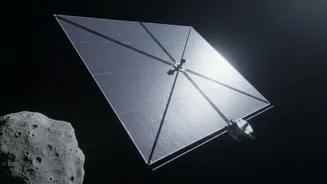
While the theory has existed for over a century, the recent "breakthrough" comes from new materials and engineering. NASA's Advanced Composite Solar Sail System (ACS3) mission is a key example of this progress. It has successfully tested new support beams, or booms, made from advanced composite materials. These booms are incredibly strong but are 75% lighter than previous metal designs and can be rolled up as tightly as a tape measure. This innovation allows for the deployment of much larger sails—the size of a small apartment or larger—from a compact satellite no bigger than a microwave oven. A larger sail catches more sunlight, generating more thrust and enabling more ambitious missions.
Destination: Near-Earth Asteroids
So, where do we go with this new technology? A primary target is the thousands of Near-Earth Asteroids (NEAs). These objects are scientific treasures, holding clues about the formation of our solar system. They are also a potential threat, and understanding their composition and orbits is a key goal for planetary defense. Missions like NEA Scout were designed to use solar sails to chase down and study these small, fast-moving targets. Chemical rockets are often too inefficient for the complex orbital adjustments needed to rendezvous with many of these asteroids. Solar sails, with their continuous low-thrust propulsion, are perfectly suited for these delicate, long-term orbital maneuvers, making them an ideal, low-cost reconnaissance tool.
A New Era of Interplanetary Travel
The successful demonstration of advanced composite solar sails marks a turning point for space exploration. This technology isn't just for small asteroid-hunters. Data from the ACS3 mission will inform the design of even larger sails, some potentially covering the area of four basketball courts. These massive sails could be used for a variety of future missions. They could position space weather satellites closer to the sun to provide earlier warnings of solar storms, act as communication relays for crewed missions to Mars, or propel probes on fast-transit journeys to the outer solar system and even interstellar space. By removing the reliance on heavy, expensive fuel, solar sailing opens the door to a more sustainable and expansive exploration of the cosmos.