


A Mission of Unprecedented Complexity
Chandrayaan-4 is not just another Moon mission; it's a quantum leap in India's space exploration capabilities. The primary objective is to collect soil and rock samples from the lunar surface and return them safely to Earth for scientific study. This
would make India only the fourth country to achieve such a feat. Unlike Chandrayaan-3, which conducted its analysis on the Moon itself, this mission requires a round trip. The plan involves a sophisticated sequence of launching, landing, collecting, ascending from the Moon, and returning to Earth, testing technologies that are crucial for future human spaceflight ambitions. This level of complexity is why the mission has been hailed as extremely challenging, even by ISRO's leadership.
The Two-Launch, Five-Module Strategy
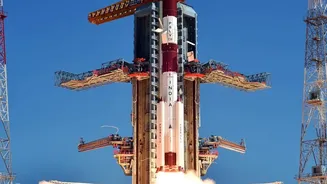
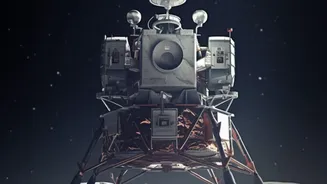
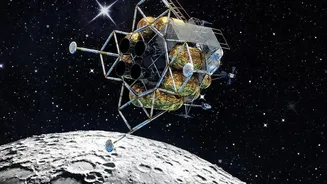
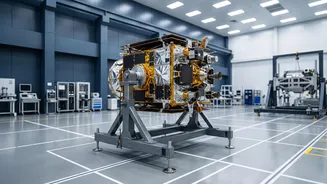
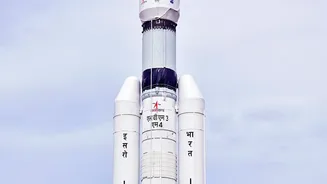
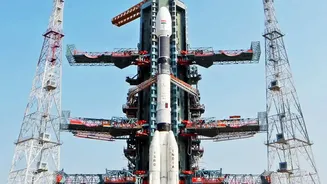
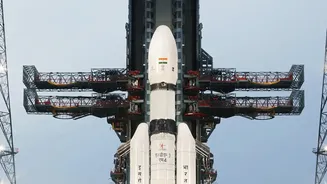
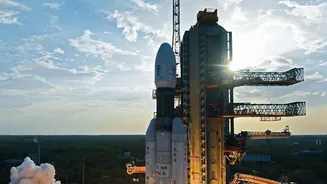
The sheer weight and number of components required for a sample return mission are too much for a single LVM3 rocket, India's most powerful launch vehicle. To solve this, ISRO has devised an ingenious two-launch strategy. The mission will use five distinct modules, split into two stacks and launched separately. One LVM3 will launch the Descender Module (DM) and the Ascender Module (AM). A second LVM3 will carry the Propulsion Module (PM), Transfer Module (TM), and a Re-entry Module (RM). After launch, these two stacks will perform a crucial, automated rendezvous and docking procedure in Earth's orbit to form one integrated spacecraft for the journey to the Moon.
Landing, Scooping, and Drilling
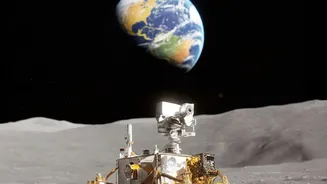
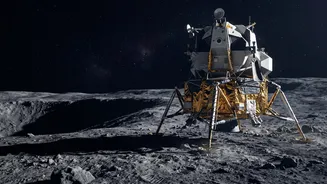
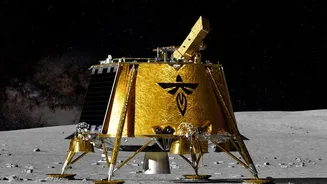
Once the integrated spacecraft reaches lunar orbit, the Descender and Ascender modules will separate and begin their descent, leveraging the precision landing experience gained from Chandrayaan-3. After a soft landing, the next critical phase begins: sample collection. A robotic arm mounted on the Descender will scoop up surface soil, or regolith. In addition, a drilling mechanism will be used to collect subsurface samples, which could offer different scientific insights. These precious samples, weighing up to a few kilograms, will be carefully transferred and sealed inside containers within the Ascender Module to protect them from contamination.
Liftoff from the Lunar Surface
This is where Chandrayaan-4 will make history for India: launching a rocket from the surface of another celestial body. The Ascender Module, carrying the lunar samples, will use the stationary Descender Module as a launchpad. It will fire its engine to lift off from the Moon and ascend into lunar orbit. This part of the mission is a major technological hurdle, requiring a lightweight, reliable rocket that can operate flawlessly in the Moon's harsh environment. The successful ascent is critical for the next stage of the journey home.
The intricate journey back to Earth
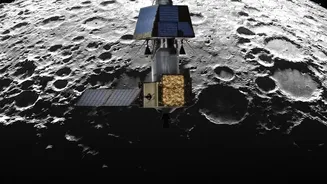
While the Ascender is making its way into lunar orbit, the Transfer and Re-entry modules will be waiting. The Ascender must then perform another automated docking, this time in lunar orbit, with the Transfer Module. Once securely docked, the sealed sample container will be transferred from the Ascender to the Re-entry Module. With the precious cargo safely stowed, the Transfer Module will fire its engines to leave lunar orbit and begin the journey back to Earth. As it approaches our planet, it will release the Re-entry Module, a capsule designed to withstand the intense heat of atmospheric re-entry, before safely landing on Earth with its unique lunar treasure.