


Seeing the Universe in a New Light
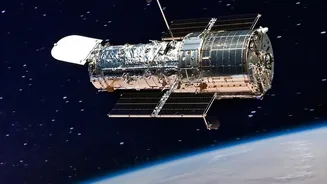
The most significant difference between the latest images from the James Webb Space Telescope (JWST) and those from its predecessor, the Hubble Space Telescope, is the kind of light they are designed to see. Hubble primarily captures visible and ultraviolet
light, similar to what our eyes perceive. JWST, on the other hand, is a specialist in infrared light. Think of it like this: Hubble shows us the universe as it appears, while JWST shows us the universe as it feels, detecting heat signatures that are invisible to the naked eye. This infrared capability allows JWST to do two revolutionary things: peer through dense clouds of cosmic dust and see light from the very first stars and galaxies. These older, extremely distant objects are moving away from us so fast that their light has stretched into the infrared spectrum, a phenomenon known as 'redshift'.
A Bigger, Colder Eye on the Cosmos
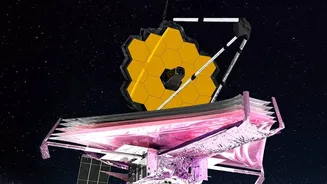
To capture faint, distant infrared signals, a telescope needs two things: a giant mirror and an extremely cold temperature. JWST excels at both. Its primary mirror is 6.5 meters (about 21 feet) across, composed of 18 gold-coated hexagonal segments. This gives it more than six times the light-collecting area of Hubble's 2.4-meter mirror. A bigger mirror acts like a larger bucket for catching light, allowing JWST to see objects that are up to 100 times fainter than what Hubble can detect. Just as important is temperature. Because infrared light is essentially heat, JWST must be incredibly cold to avoid its own heat interfering with its observations. It operates at around a frosty -220 degrees Celsius, shielded from the heat of the Sun, Earth, and Moon.
A Superior Vantage Point in Space
Where a telescope is located makes a huge difference. Hubble is in low Earth orbit, about 570 kilometers up, meaning it is close to the heat and light radiating from our planet. It also passes in and out of Earth's shadow every 90 minutes, limiting its continuous observation time. JWST, by contrast, is positioned 1.5 million kilometers (nearly a million miles) from Earth at a special spot called the second Lagrange point, or L2. At this gravitationally stable point, the telescope can keep the Sun, Earth, and Moon all in one direction, allowing its massive, five-layer sunshield to block their heat and light simultaneously. This orbit provides JWST with a constant, unobstructed view of deep space in a thermally stable environment, perfect for its sensitive infrared mission.
Peering Through Dust and Back in Time
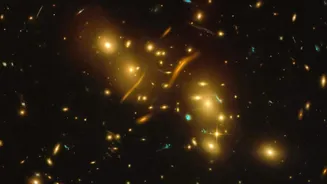
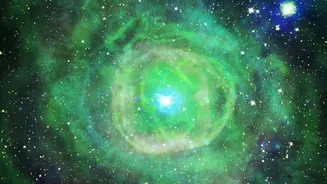
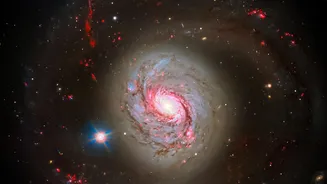
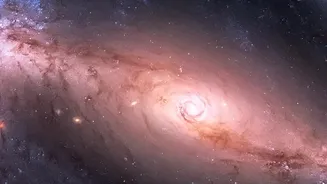
The combination of infrared vision, a massive mirror, and a cold, distant orbit gives JWST its unique scientific power. Cosmic dust, which appears as opaque clouds to Hubble, is like smoke that JWST can see right through. This has unveiled the hidden birthplaces of stars and planets, revealing complex structures within nebulae that were previously obscured. For example, when viewing the iconic Pillars of Creation, Hubble sees magnificent towers of gas and dust, but JWST's infrared gaze penetrates them to reveal the glowing, newborn stars within. Moreover, by capturing the redshifted light from the dawn of time, JWST acts as a time machine. It can spot galaxies that formed just a few hundred million years after the Big Bang, allowing scientists to study how the very first cosmic structures came to be. Recent images, such as one of the galaxy cluster MACS J0553.4-3342, show us what the universe looked like over 4.4 billion years ago.
The Visual Telltale Signs
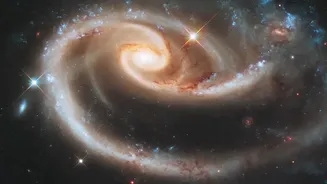
Beyond the science, there is an easy way to tell a JWST image from a Hubble image just by looking at the stars. Because of the way light diffracts, or bends, around the structures inside a telescope, bright stars in images have spikes. In a Hubble image, stars typically have four distinct spikes, forming a cross shape. This is caused by the four struts that hold its secondary mirror in place. In a JWST image, the stars have a characteristic eight-pointed starburst or snowflake pattern—six large spikes and two smaller, fainter ones. This unique signature is a result of the 18 hexagonal segments of its primary mirror and the three struts holding its secondary mirror.