




In the vast cosmic ocean, astronomers have found thousands of worlds orbiting distant stars. Among the most intriguing and common are 'super-Earths', a class of planet our own solar system mysteriously lacks. What exactly makes a planet 'super'?
More Than Earth, Less Than Neptune
The term
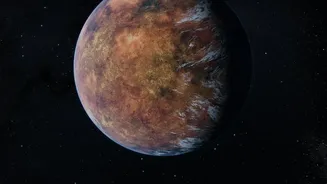
'super-Earth' is a simple reference to a planet's size and mass. It doesn’t mean they are necessarily like our home world, just that they are bigger. Specifically, a super-Earth is an exoplanet with a mass higher than Earth’s but substantially below that of our solar system's ice giants, Uranus and Neptune. The general range is between two and ten times the mass of Earth. In terms of size, they are larger than Earth but smaller than Neptune, which has a radius about four times our planet's. This places them in a unique category of planets that are a common sight in the galaxy, yet entirely absent from our own cosmic neighbourhood.
A Diverse and Mysterious Family
While the name might conjure images of a bigger, better Earth, the reality is far more diverse and complex. The 'super-Earth' label only refers to mass and size, not to a planet's surface conditions or composition. A super-Earth could be a rocky world like Mars or Earth, but it could also be a 'water world' with deep, global oceans, or even a 'mini-Neptune' with a dense, gassy atmosphere and no solid surface at all. Some, like 55 Cancri e, orbit so close to their star that their surfaces are scorching oceans of lava, completing a full year in less than 18 hours. This variety is exactly what makes them so fascinating, as they challenge our assumptions about how planets form and what they can be like.
The Galaxy's Most Common Planet
One of the most surprising findings in modern astronomy is just how many super-Earths are out there. Current estimates suggest they make up roughly a third of all known exoplanets, making them the most common type of planet in the Milky Way. Studies indicate that tens of billions of super-Earths could exist in our galaxy alone. This abundance is a major puzzle for astronomers. Given how frequently they appear around other stars, especially cooler dwarf stars, their absence in our own solar system is a significant anomaly. Studying them helps scientists refine theories of planetary formation to explain why our solar system looks so different from the galactic norm.
Prime Candidates in the Search for Life
Because they are bigger and more massive than Earth, super-Earths are easier for astronomers to find and study. This makes them prime targets in the search for habitable worlds. Many super-Earths, like Kepler-186f and Proxima Centauri b, have been discovered within their star's 'habitable zone'—the orbital region where temperatures could allow liquid water to exist on the surface. Scientists believe that some super-Earths might even be 'superhabitable'. Their larger mass could allow them to remain geologically active for longer, which helps regulate climate and sustain a protective magnetic field. A thicker atmosphere could provide better insulation and protection from cosmic radiation. While their higher gravity might pose a challenge for life as we know it, these worlds represent some of the most compelling places to look for life beyond Earth.