


Beyond the Basics
For a long time, the chemistry of interstellar space was thought to be relatively simple. The prevailing view was that the harsh, cold, and empty environment between stars could only support the formation of basic molecules. Scientists expected to find
mostly hydrogen, helium, and a handful of other simple compounds. The idea that more complex, life-relevant molecules could form in such unforgiving conditions seemed unlikely. Most theories suggested that the real chemical magic, the kind that creates the building blocks of life, happened much later in the dense, hot disks of gas and dust that eventually form stars and planets. This model painted a picture of a universe where complexity was the exception, not the rule, and the ingredients for life were rare.
A Chemical Treasure Trove Revealed
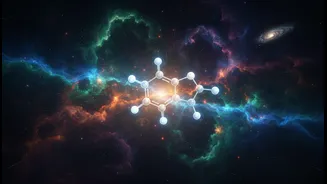
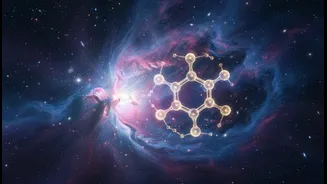
Modern telescopes, especially the James Webb Space Telescope (JWST), have completely upended that simple picture. By peering into dust-shrouded regions that were previously hidden, astronomers are uncovering a stunning diversity of organic molecules. In one ultra-luminous galaxy, the JWST detected a trove of carbon-rich compounds including benzene, methane, and the highly reactive methyl radical—seen for the first time outside our Milky Way. The sheer abundance of these molecules was far higher than any existing models had predicted, suggesting our theories were missing a key piece of the puzzle. These findings indicate that the nuclei of distant galaxies might be acting as massive chemical factories, constantly churning out organic compounds that could serve as precursors to more complex chemistry.
Finding Sugar Among the Stars
Perhaps one of the most surprising recent discoveries has been the detection of a true sugar molecule, erythrulose, in a molecular cloud near the center of our galaxy. This was the first time a sugar has been directly observed in interstellar space. While sugars like glucose have been found in meteorites before, finding one floating freely in a gas cloud suggests the chemical groundwork for life begins long before planets even form. Erythrulose, a four-carbon sugar also found in raspberries, was surprisingly abundant, challenging the idea that cosmic molecules grow slowly one carbon atom at a time. Its presence in the raw material from which stars and planets are born hints that these essential compounds might be delivered to new worlds from the very beginning.
The Building Blocks of Life Are Everywhere
The discoveries are not limited to sugars. In January 2026, researchers announced the detection of the largest sulfur-bearing molecule ever found in space, a 13-atom ring-shaped compound. This was a significant find because sulfur is essential for proteins and enzymes, and its presence in such a large molecule closes a gap between simple space chemistry and the complex organics found in comets and meteorites. In another study, astronomers found complex organic molecules like ethanol and acetic acid frozen in the icy dust around a protostar in a neighboring galaxy. And scientists have even shown that peptides, the linked chains of amino acids that form proteins, can form in the extreme cold of deep space—as low as –260°C. This suggests that the starter kits for life are not rare, but are instead scattered across the cosmos.