



Why Is Lunar Ice So Important?
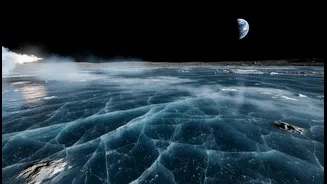
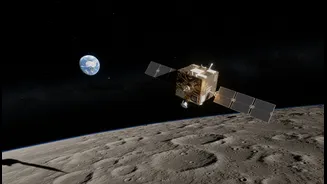
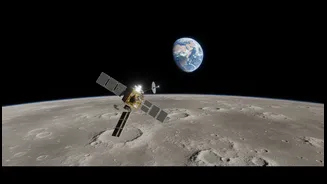
For decades, the Moon was considered a completely dry, barren world. But recent discoveries, including data from India's Chandrayaan-1 mission, have confirmed the presence of water ice, particularly in Permanently Shadowed Regions (PSRs) near the poles.
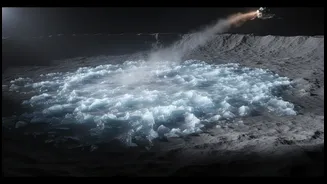
These are craters so deep that their floors haven't seen sunlight in billions of years, creating natural cold traps where ice can accumulate and remain stable. This ice is a game-changer for two reasons. First, for future explorers, it represents a vital local resource. Water can be used for drinking and growing food, and it can be broken down into hydrogen and oxygen—breathable air and the primary components of rocket fuel. This could one day make lunar bases and deep-space refueling stations a reality. Second, and perhaps more profoundly, this ice is a scientific time capsule. Trapped within it could be clues to the origin of water in our solar system and the prebiotic organic molecules that were the building blocks of life on Earth. Since Earth’s geology has constantly recycled its ancient history, the Moon’s pristine ice offers an undisturbed record we can't find anywhere else.
The Problem with Rocket Exhaust
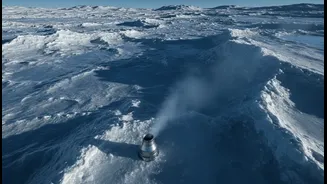
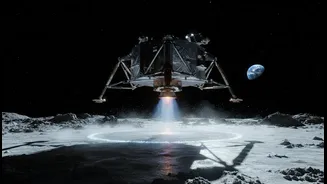
The challenge is that accessing these pristine environments without spoiling them is incredibly difficult. When a spacecraft lands on the Moon, its engines blast the surface, kicking up dust and releasing exhaust. A major component of this exhaust is water vapor, along with other compounds like methane. On Earth, an atmosphere would contain this plume. But in the Moon's near-vacuum, the exhaust cloud expands rapidly and globally. Recent computer simulations show that exhaust from a single landing near one pole can spread across the entire lunar surface in a matter of hours or days. A significant portion of these exhaust molecules eventually gets trapped in the same super-cold PSRs that hold the ancient, native ice. This creates a serious contamination problem. Future scientists drilling into the ice won't know if the water or organic molecules they find are part of the Moon's ancient record or just residue from the lander that brought them there. It’s like trying to study an ancient fossil after someone has accidentally spilled glue all over it.
What Is Planetary Protection?
This is where the concept of 'planetary protection' comes in. It's a guiding principle for space exploration designed to prevent biological contamination between Earth and other celestial bodies. It works two ways. 'Forward contamination' is the effort to avoid introducing Earthly microbes and materials to other worlds, which could corrupt scientific experiments searching for alien life or harm potential extraterrestrial ecosystems. 'Backward contamination' is about protecting Earth from any potential extraterrestrial life forms that might be brought back on sample-return missions. The legal basis for this principle comes from the 1967 Outer Space Treaty, which obligates nations to avoid the "harmful contamination" of space and other celestial bodies. An international body of scientists called the Committee on Space Research (COSPAR) provides the specific guidelines that agencies like NASA follow.
What Are the Rules for the Moon?
Historically, the Moon has had very few planetary protection restrictions. After the Apollo missions, scientists concluded it was not a place where Earth life could survive or multiply, so it was considered low-risk. However, the discovery of water ice and its scientific importance prompted a re-evaluation. In 2008, COSPAR upgraded the Moon's status, and more recently, it created a special sub-category for missions targeting the polar regions. While most of the Moon's surface only requires missions to report their inventory of organic materials, the rules are becoming more considered for the PSRs. The goal isn't to prohibit exploration but to ensure it's done responsibly, documenting what we release into the environment so future scientists can account for it. This is becoming urgent as a new wave of government-led Artemis missions and private commercial landers set their sights on the very same ice-rich polar regions.