





The Copyright Conundrum
For creators and businesses, the most pressing question is: who owns AI-generated content? The legal landscape, especially in India, is a significant grey area. The Indian Copyright Act, 1957, was not designed for non-human creators. As it stands, global
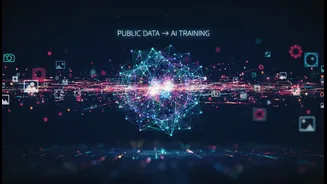
consensus is leaning towards the idea that work generated entirely by AI cannot be copyrighted because it lacks a human author. While a case in India did see an AI temporarily registered as a co-author, the approval was later withdrawn, highlighting the ongoing uncertainty. This means that the brilliant marketing copy, logo design, or article you generated might not be legally yours to protect. If you build a brand on assets you can't own, you have no legal recourse if a competitor uses the exact same material. Furthermore, the AI model itself was trained on vast amounts of data, including copyrighted works, which can lead to it producing content that is substantially similar to existing protected material, creating a risk of infringement.
Your Data Is Not Always Private
For small teams and businesses, confidentiality is paramount. However, when employees use free, consumer-grade versions of ChatGPT, they might be inadvertently feeding sensitive information into the model. This could include proprietary source code, confidential client information, or internal financial data. In 2023, a major tech company famously suffered a leak after employees pasted sensitive code into ChatGPT. The default settings on these consumer accounts often allow the company, like OpenAI, to use your inputs to train future models. While enterprise-level subscriptions offer greater data protection and assurances that your data won't be used for training, the risk of 'shadow AI'—employees using unsanctioned personal accounts—remains a major security blind spot for companies. Before inputting any information, assume it could become public.
The Illusion of Accuracy
Large Language Models are designed to generate plausible-sounding text, not to be factually accurate. This leads to a phenomenon known as 'hallucination', where the AI confidently states incorrect information or even invents facts and sources. Studies have shown that hallucination rates can be surprisingly high, with models fabricating references and misrepresenting data. This is a critical risk for students and researchers. Many have confessed they were not aware that AI could be wrong. Relying on ChatGPT for a research paper or report without rigorously fact-checking every single claim against primary sources can lead to submitting work filled with errors. This not only results in poor grades but undermines the entire learning process.
Academic and Professional Integrity
Beyond factual errors, the use of AI in academia raises serious ethical questions. In India, the University Grants Commission (UGC) has made it clear that while there isn't a separate notification for AI, existing plagiarism rules apply. Using AI-generated text without proper disclosure is considered academic misconduct. Many Indian universities are now updating their policies, specifying that AI can be used for assistance, like language editing, but not to generate the core intellectual work. Violations could lead to severe penalties, including the cancellation of a student's registration. For professionals and creators, over-reliance on AI can atrophy critical thinking, problem-solving, and writing skills. If everyone uses the same tools to generate content, it leads to a homogenised, less creative world where it's impossible to stand out.