





Seeing the Invisible
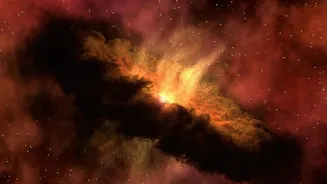
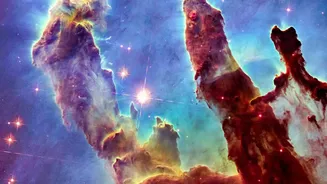
Stellar nurseries, the vast cosmic clouds where stars are born, are notoriously dusty places. This dust, composed of tiny particles of carbon and silicates, is like a thick fog that blocks visible light, making it impossible for traditional telescopes
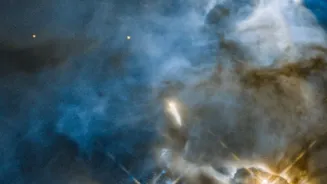
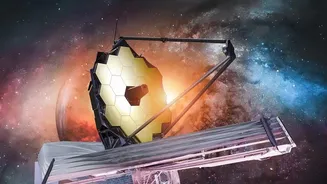
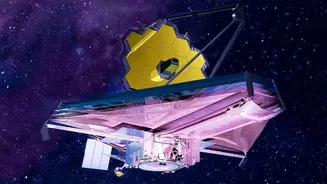
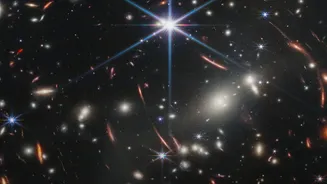
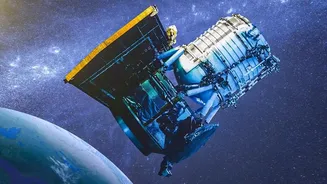
to see the infant stars and planetary systems forming within. However, infrared light, which has a longer wavelength, can pass through these dense clouds largely unimpeded. Telescopes like the James Webb Space Telescope (JWST) are designed specifically to capture this infrared light. This allows astronomers to peer into the heart of these nurseries, transforming opaque clouds into translucent windows that reveal the complex processes unfolding inside. What was once a dark, impenetrable region of space is now a landscape of glowing gas and emerging stars.
The Chaos of Creation
The images returning from telescopes like JWST are painting a far more dynamic and chaotic picture of planet formation than previously imagined. Instead of a slow, orderly process, infrared views show young stars unleashing powerful jets and winds that sculpt the surrounding gas and dust into dramatic shapes, like hourglasses and cosmic cliffs. These outflows carve out vast cavities within the nebulae and send shockwaves through the material from which planets are trying to form. By observing these turbulent environments, scientists can see how the intense radiation from massive young stars can influence, and in some cases even hinder, the development of planets in their vicinity. For instance, the powerful radiation can strip away the gas from a protoplanetary disk, potentially preventing the formation of large gas giants like Jupiter.
Blueprints for New Worlds
At the center of this chaos are the protoplanetary disks—swirling platters of gas and dust that surround newborn stars. It is within these disks that the building blocks of planets coalesce. Infrared spectroscopy, a technique that analyzes the composition of light, allows scientists to identify the chemical ingredients present, including water ice and complex organic molecules—the very materials needed for life as we know it. Furthermore, infrared cameras can image the structure of these disks with stunning clarity, revealing rings and gaps. These gaps are considered tell-tale signs that a young planet is forming, clearing a path in its orbit as it gathers material. In some cases, astronomers have been able to directly image these newborn protoplanets, capturing them as glowing hot spots within their parent disk.
Rewriting the Planetary Playbook
These new infrared observations are not just providing pretty pictures; they are actively rewriting scientific models of planet formation. For years, theories suggested that in the early universe, where heavy elements were scarce, planet-forming disks would have very short lifespans, making it difficult for large planets to form. However, recent infrared studies have challenged this by showing that disks in environments with few heavy elements can actually live longer than those in our own galaxy. This discovery implies that planets had more time to grow in the early universe than previously thought. Additionally, observations of how quickly gas is dispersed from these disks provide crucial information on the timeframe available for gas giants to form their massive atmospheres. Each new dataset helps refine our understanding of the timelines and conditions required to build planetary systems, offering a glimpse into the processes that likely shaped our own solar system billions of years ago.