






The Ocean's Climate Memory
Covering more than two-thirds of our planet, the ocean acts as a massive climate regulator. Its deep waters, below 200 meters, make up the largest habitat on Earth and play a central role in stabilizing our climate system. This immense volume of water absorbs
and stores enormous quantities of heat and carbon dioxide (CO2) that would otherwise remain in the atmosphere. By soaking up about a quarter of all human-caused CO2 emissions and the vast majority of excess heat, the ocean serves as a critical buffer against more rapid climate change. This makes the deep ocean an essential, albeit hard to reach, memory bank for the planet's climate, recording changes over decades and centuries. Scientists tap into this record to understand not just the current state of our climate, but where it is headed.
An Armada of Robotic Floats
One of the most revolutionary tools for monitoring the ocean is the Argo program, an international effort involving a global array of nearly 4,000 robotic floats. These autonomous instruments drift with the currents and execute a programmed 10-day cycle. They sink to a depth of 2,000 meters, drift for about nine days, then descend further before rising back to the surface. On their ascent, sensors measure crucial data points like temperature, pressure, and salinity. Once at the surface, the floats transmit their data to satellites before repeating the cycle. This has provided an unprecedented, year-round view of the upper half of the ocean's volume, far from traditional shipping lanes and in all weather conditions. Now, new Deep Argo floats are being deployed to reach depths of up to 6,000 meters, helping scientists understand how heat and carbon are stored in the ocean's deepest layers.
Stationary Sentinels and Undersea Cables
While Argo floats provide broad coverage, stationary observatories offer a different kind of insight. Moored buoys and seafloor-anchored systems provide continuous, long-term data from a single, critical location. These moorings can be equipped with a suite of sensors measuring everything from currents to temperature to water chemistry. For instance, the Ocean Observatories Initiative operates several such high-tech systems, with instruments anchored to the seafloor that provide data from the abyss all the way to the surface. These fixed stations are vital for understanding phenomena like marine heatwaves and ocean acidification in specific regions. They act as a constant reference point, allowing scientists to detect subtle shifts and calibrate data collected by mobile platforms like floats and gliders.
Listening to the Ocean's Past
To understand today's climate signals, scientists must look into the past. This is the work of paleoceanography, which reconstructs ancient ocean conditions by studying sediment cores drilled from the seafloor. These long cylinders of mud contain the fossilized shells of tiny marine organisms called foraminifera. The chemical composition of these shells, such as the ratio of magnesium to calcium, can reveal the temperature of the water in which they lived centuries or millennia ago. The size of sediment grains can even indicate the speed of ancient deep-ocean currents. By analyzing these layers, with the oldest at the bottom, scientists can build a timeline of past ocean temperatures and circulation, providing crucial context for the changes being observed today.
Sound Waves and Satellites
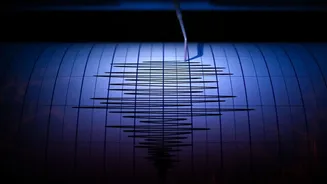
Ingenious methods also allow scientists to take the ocean's temperature from both above and within. Satellites can't see into the deep ocean, but they can precisely measure sea surface height; as water warms, it expands, causing sea levels to rise. Another technique, called ocean acoustic tomography, uses sound to measure temperature over vast distances. Sound travels faster in warmer water, so by sending an acoustic pulse from a source to a receiver thousands of kilometers away and timing its arrival, scientists can calculate the average temperature along that path. Some researchers are even using the sounds from undersea earthquakes as a natural source for these measurements, providing a clever way to monitor large-scale ocean warming.