


The Technique: Seeing What Isn't There
To find a planet with a stable, life-supporting atmosphere, astronomers first need to understand what makes an atmosphere disappear. This process is called atmospheric escape, where a planet's blanket of gas is stripped away and bleeds into space. The
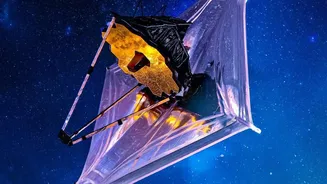
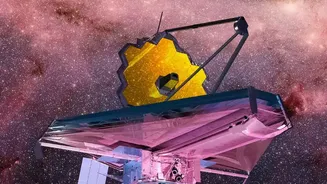
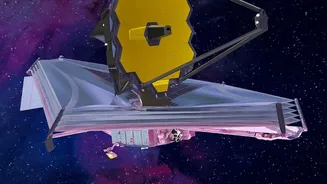
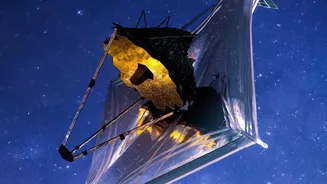
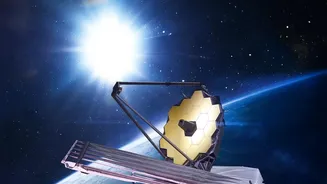
JWST is uniquely equipped to witness this phenomenon. Using a method called transmission spectroscopy, the telescope watches as an exoplanet passes in front of its host star. As starlight filters through the planet’s atmosphere (or what’s left of it), different gases absorb specific wavelengths of light. This leaves a chemical fingerprint that JWST’s sensitive instruments can read, revealing not only what gases are present but also how quickly they are escaping. By studying planets in various states of atmospheric loss, scientists build a library of failure modes, which is critical for identifying worlds that have succeeded.
The Prime Suspect: The Host Star
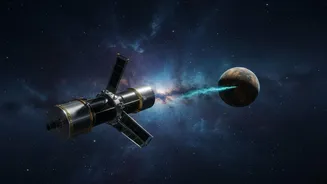
A planet’s relationship with its star is a double-edged sword. The star provides the warmth and energy necessary for life, but it can also be a destructive force. Many of the most common stars in our galaxy are red dwarfs, which are smaller and cooler than our Sun. Planets must orbit them very closely to be in the 'habitable zone' where liquid water could exist. However, this proximity exposes them to intense radiation and violent stellar flares, which can blast away an atmosphere over time. JWST has observed this in action, studying planets like WASP-107b, a 'super-puff' world whose atmosphere is so dramatically escaping that a huge tail of helium gas actually precedes the planet in its orbit. Observing this extreme atmospheric loss helps scientists create models that predict which planets, based on their size, distance from their star, and the star's activity level, are likely to be barren rocks versus those that could hold onto their air.
From Gas Giants to Rocky Worlds
Much of JWST's early work on atmospheric escape has focused on gas giants and 'hot Jupiters' like WASP-121b. These large, hot planets provide a dramatic and more easily observable laboratory for studying this process. The lessons learned here are directly applicable to the much harder task of studying smaller, rocky worlds. The goal is to find Earth-sized planets that have avoided atmospheric stripping. Systems like TRAPPIST-1, which features multiple Earth-sized planets orbiting a red dwarf, are prime targets. While JWST has yet to definitively confirm a stable, thick atmosphere on a rocky habitable-zone planet, its observations are ruling out certain scenarios. For instance, on some worlds, it has ruled out thick, hydrogen-dominated atmospheres, leaving open the possibility of thinner, nitrogen-based atmospheres like Earth's or no atmosphere at all.
Creating a Habitable Planet Checklist
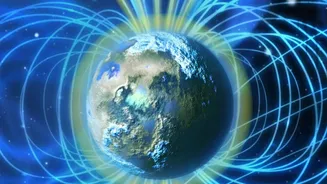
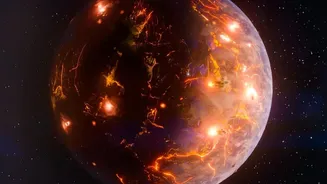
Every observation of a planet losing its atmosphere, or one that is already a bare rock, adds a crucial data point to the search for life. It helps astronomers refine their definition of a 'truly habitable' world. Instead of just a planet of the right size at the right distance from its star, the checklist grows more sophisticated. Does the planet have a magnetic field strong enough to deflect stellar radiation? Is its host star relatively stable? Does its gravity allow it to hold onto heavier gases like nitrogen and carbon dioxide while lighter ones like hydrogen escape? By studying the 'failed' planets—the scorched, airless worlds and the ones actively shedding their gases—JWST provides the essential context. It shows what can go wrong, allowing scientists to better recognize the specific and rare combination of factors that must go right for a planet to be a potential home for life.