








Understanding the Foot-Posture Connection
Flat feet, or 'pes planus', occur when the arches on the inside of your feet are flattened, allowing the entire sole to touch the floor when you stand. For many, this is a painless and normal variation. For others, it can lead to a cascade of postural
shifts. When the arch collapses, the ankle can roll inward (a motion called overpronation). This rotation can continue up the kinetic chain, potentially misaligning the knees, hips, and even the lower back. Over time, this can contribute to discomfort, inefficient movement patterns, and what we perceive as 'bad posture'. The goal isn't necessarily to build a high, rigid arch, but to strengthen the intrinsic muscles of the feet so they can properly support and stabilise your body.
Why Barefoot? Why the Lawn?
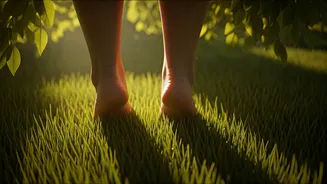
Modern shoes, especially those with thick, cushioned soles and rigid support, can act like a cast for our feet. They prevent the 26 bones, 33 joints, and over 100 muscles, tendons, and ligaments in each foot from doing their job. Going barefoot encourages your feet to feel and adapt to the ground, a process that awakens dormant muscles and enhances proprioception—your brain's awareness of your body's position in space. A soft, slightly uneven surface like a lawn is the ideal starting gym for your feet. It's forgiving, provides gentle sensory feedback, and encourages your foot muscles to constantly make micro-adjustments to maintain balance, effectively strengthening them with every step.
Safety First: Preparing for Your Drills
Before you kick off your shoes, take a moment to prepare. First, inspect your lawn. Walk the area and clear it of any sharp objects like stones, sticks, glass, or pet waste. Your feet will be more sensitive at first, so ensure the ground is safe. Second, start slow. If you're used to wearing supportive shoes all day, your foot muscles will be deconditioned. Begin with just 5–10 minutes of barefoot time and gradually increase the duration as your feet get stronger. Listen to your body. Some initial muscle soreness in your arches and calves is normal, but sharp or persistent pain is a sign to stop and rest. Never push through pain.
Drill 1: Mindful Barefoot Walking
This is the foundation. Instead of just walking aimlessly, focus on your form. Walk slowly across the lawn, concentrating on landing gently on your midfoot or the outer edge of your heel, then rolling through your foot and pushing off with your big toe. Pay attention to how the grass feels under your soles. Spread your toes and let them grip the earth. Try walking forwards, backwards, and even sideways to challenge different muscle groups. The goal is to make walking an active exercise in sensory awareness, not just a way to get from one point to another. Do this for 3-5 minutes at the beginning of each session.
Drill 2: The 'Short Foot' Exercise
This is a key exercise for activating the deep muscles that support the arch. Stand with your feet flat on the ground, hip-width apart. Without curling your toes or lifting them off the ground, try to slide your big toe knuckle back towards your heel. You are not physically moving your foot; you are contracting the muscles in your arch to 'dome' it upwards. You should feel the arch lift and the foot shorten slightly. Hold the contraction for 5 seconds, then relax. This is a subtle but powerful movement. Aim for 10-15 repetitions on each foot.
Drill 3: Toe Splays and Lifts
To improve dexterity and control, work on your toes. While standing, try to lift all your toes off the ground while keeping the ball of your foot planted. Then, try to 'splay' or spread them as wide as possible before placing them back down one by one, like playing a piano. Next, try the reverse: keep your four smaller toes on the ground and lift only your big toe. Then, press your big toe down and try to lift the other four. These movements can be surprisingly difficult at first, but they are excellent for building neuromuscular control in your feet.
Putting It All Together Weekly
Consistency is more important than intensity. Aim to perform these drills 2 to 3 times per week. A simple routine could look like this: begin with 3-5 minutes of mindful walking to warm up. Follow this with two sets of 10-15 repetitions of the Short Foot exercise and Toe Splay/Lift drills on each foot. Finish by standing on one leg for 30 seconds (or as long as you can) to challenge your balance, then switch. As this gets easier, you can do it with your eyes closed. This entire routine should take no more than 15 minutes, making it an easy and sustainable habit to build into your week.