
Meet NASA’s Next Great Observatory
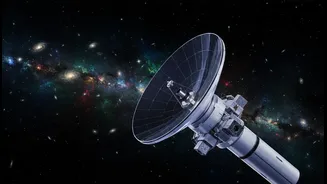
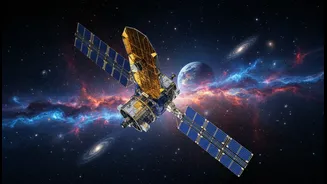
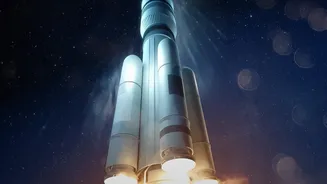
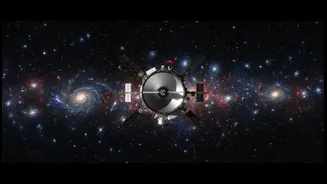
Scheduled for launch in August 2026, the Nancy Grace Roman Space Telescope is NASA's next flagship astrophysics mission. Named after Dr. Nancy Grace Roman, NASA’s first Chief of Astronomy who is often called the “mother of Hubble,” this observatory is engineered
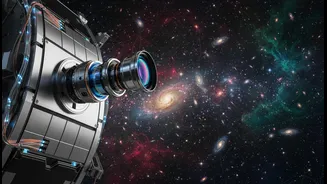
for discovery on a grand scale. Its main goals are to investigate the mysteries of dark energy and dark matter, search for exoplanets, and explore a wide range of infrared astrophysics. Unlike its predecessors, Roman’s defining feature is its incredible efficiency in mapping the cosmos. It carries a Wide Field Instrument (WFI) equipped with a 300.8-megapixel camera that will capture enormous swathes of the sky with the same sharp resolution as the Hubble Space Telescope. This capability will allow it to gather data at a much faster rate, creating vast celestial maps that will fuel scientific research for decades.
A Tale of Two Telescopes
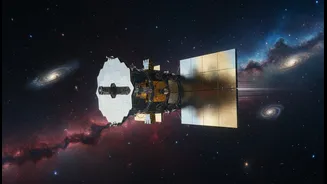
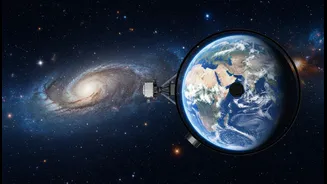
To understand how Roman and Webb will work together, it’s best to think of them as specialists with different but complementary tools. The James Webb Space Telescope (JWST) is like a powerful magnifying glass. Its massive 6.5-meter primary mirror allows it to peer deep into the universe with incredible sensitivity, capturing faint light from the very first galaxies. This gives it an extremely detailed but narrow view of a small patch of sky. In contrast, the Roman Space Telescope is like a panoramic camera. Its 2.4-meter mirror is the same size as Hubble's, but its innovative instrument design gives it a field of view 100 times larger than Hubble's or Webb’s infrared cameras. In the time it takes Webb to observe a tiny sliver of the cosmos in exquisite detail, Roman can survey a massive area, identifying countless new objects and phenomena.
The Power of a Cosmic Partnership
The true breakthrough lies in combining these two different approaches. Roman will act as a cosmic scout, rapidly surveying huge patches of the sky to find interesting and rare targets. These could be anything from rogue planets not orbiting a star, to extremely distant and ancient quasars, or the explosive aftermath of a supernova. Once Roman identifies these targets, its findings can be passed to Webb for a more focused and detailed follow-up. Webb can then use its powerful spectrometers and deep-field imaging to analyze the chemical composition of an exoplanet’s atmosphere or determine the precise distance to a primordial galaxy that Roman discovered. This two-step process—Roman finding and Webb investigating—will dramatically accelerate the pace of discovery, allowing scientists to answer questions that neither telescope could tackle as effectively on its own.
Unlocking Dark Energy and Exoplanets
This powerful collaboration will be crucial for tackling some of the biggest questions in modern astronomy. One of Roman's key missions is to study dark energy, the mysterious force causing the universe to expand at an accelerating rate. By surveying billions of galaxies and thousands of supernovae, Roman will create a 3D map of the universe across cosmic time, which will help constrain our theories about dark energy. In the search for planets beyond our solar system, Roman is expected to find thousands of new worlds using a technique called gravitational microlensing. This method is sensitive to planets far from their star, a population that other methods often miss. Webb can then follow up on intriguing nearby systems, perhaps even directly imaging larger planets and studying their atmospheres, bringing us closer to understanding the diversity of worlds in our galaxy.