


The 'Failed Stars' of the Cosmos
Imagine a star that never quite made it. That’s a brown dwarf. These celestial objects form from collapsing clouds of gas and dust, just like stars do. But they never accumulate enough mass to kickstart the nuclear fusion of hydrogen in their cores, the process
that makes stars like our Sun shine brightly. Instead, they are often called 'failed stars', occupying a fascinating middle ground between the largest gas giants, like Jupiter, and the smallest stars. They glow dimly from the residual heat of their formation, slowly cooling over billions of years and emitting most of their light in the infrared spectrum, which is invisible to the human eye.
An All-Sky Surveyor Called SPHEREx
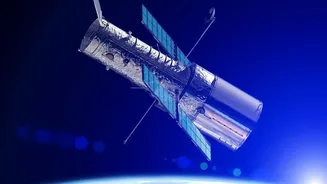
Enter NASA's SPHEREx mission, which stands for Spectro-Photometer for the History of the Universe, Epoch of Reionization, and Ices Explorer. Launched in March 2025, this space telescope is on a two-year mission to map the entire sky in infrared light, a feat that is extremely difficult from the ground because Earth's atmosphere absorbs many of these wavelengths. By measuring the brightness of celestial objects across 102 different colour bands, SPHEREx creates a unique spectral fingerprint for each one. This allows scientists to identify the chemical composition of everything from distant galaxies to the atmospheres of nearby objects, including our enigmatic brown dwarfs.
A Storm of Unexpected Data
The latest findings, published in The Astrophysical Journal, are based on SPHEREx's detailed observations of 37 nearby brown dwarfs. The study reveals that these worlds have chemically rich atmospheres containing water, methane, carbon dioxide, and carbon monoxide. More importantly, the data shows a startling amount of diversity. According to Zafar Rustamkulov, the study's lead author, 'No two brown dwarfs are alike. Even at the same temperature, their spectra look quite distinct'. This variation is particularly noticeable in brown dwarfs that are in a transitional phase. As they cool, their exotic clouds of silicate dust and iron droplets are expected to thin out, changing the atmospheric chemistry. However, the new SPHEREx data doesn't quite line up with what scientists predicted.
Why the Old Models Are Crumbling
For years, astronomers have used complex computer models to understand the atmospheres of these objects. While these models have been successful in predicting general chemical trends, they are struggling to match the detailed data from SPHEREx, especially during the cloudy transition phase. The study found that existing models couldn't fully reproduce the brightness observed across the infrared spectrum. In some cases, to make the data fit, the models produced physically unrealistic sizes for the brown dwarfs, sometimes off by as much as 20–50%. This suggests our fundamental understanding of cloud physics and atmospheric chemistry on these 'super-planets' is incomplete. The new observations are a 'call to action' for theorists to refine their models.
Why These Cosmic Clouds Matter
This might seem like a distant, abstract problem, but it has significant implications. Brown dwarfs serve as a natural laboratory for understanding the atmospheres of giant exoplanets orbiting other stars. It's much easier to study a lone brown dwarf than an exoplanet that is lost in the glare of its parent star. If our models can't accurately describe the atmospheres of brown dwarfs, they likely have similar flaws when applied to exoplanets. As coauthor J. Davy Kirkpatrick noted, this work has turned the research team into 'accidental meteorologists' for other worlds. By correcting the models for brown dwarfs, scientists can create more accurate tools to search for and characterize potentially habitable planets elsewhere in our galaxy.