



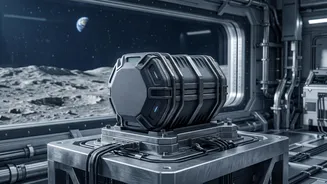


The Ultimate Logistics Problem
Establishing a lunar base is less a question of ambition and more one of logistics. Launching materials from Earth is prohibitively expensive, making the prospect of shipping bricks, metal, and water across 384,400 kilometers unsustainable. To build habitats,
landing pads, and radiation shields, space agencies are focusing on a strategy called In-Situ Resource Utilization, or ISRU. The principle is simple: live off the land. By harnessing lunar resources, missions can drastically reduce their dependency on Earth. This approach is the cornerstone of plans by NASA, the European Space Agency (ESA), and other global players to create a sustainable and long-term settlement on the Moon. The focus is on two key technologies to turn this vision into reality: robotic excavation and large-scale 3D printing.
Digging Deep with Lunar Robots
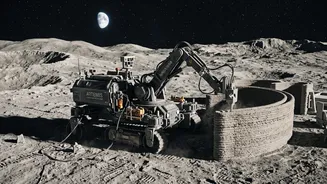
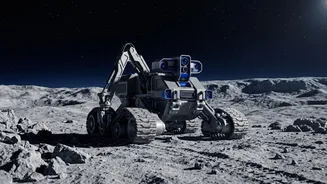
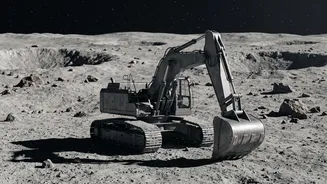
The first step in building with local materials is collecting them. The Moon's surface is covered in a layer of fine, abrasive dust and rock called regolith. This isn't just dirt; it's a valuable resource rich in oxygen and metals like iron and titanium. To mine it, a new generation of autonomous robots is being developed. NASA's RASSOR (Regolith Advanced Surface Systems Operations Robot) and the newer Infrastructure Pilot Excavator (IPEx) are designed to operate as both bulldozers and haulers. These robots are engineered to be lightweight yet powerful enough to scoop and transport tonnes of regolith in the Moon's low gravity. Private-public partnerships are also accelerating this technology, with companies like Interlune and Vermeer collaborating on commercial excavators capable of moving 100 tonnes of lunar soil per hour, with mission-ready tools expected by 2028.
Printing a Home on the Moon
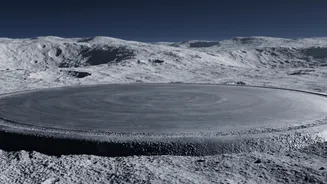
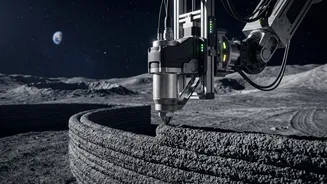
Once the regolith is collected, it becomes the 'ink' for construction. Both NASA and ESA are heavily invested in developing 3D printing technologies that can turn this raw material into solid structures. The process involves using a binding agent or advanced methods like solar or laser sintering to melt the regolith layer by layer, fusing it into a hard, ceramic-like material. Architectural firms like Foster + Partners have collaborated with ESA to design habitats using this method, envisioning an inflatable dome that is then covered by a 3D-printed regolith shell. This hollow-celled, bone-like structure would provide protection from micrometeoroids and cosmic radiation. Prototypes using simulated lunar soil have already been created, proving the concept's viability for building everything from landing pads to entire habitats.
Radiation, Dust, and Other Hurdles
Constructing a lunar base is not without significant challenges. The Moon is an extreme environment with no atmosphere, wild temperature swings, and constant radiation. The regolith itself, while a valuable resource, is also a hazard. The dust particles are as fine as powder but sharp as glass, capable of damaging equipment and posing a health risk to astronauts. Robots must be designed to withstand these conditions, operating autonomously to minimize human exposure. Furthermore, signal delays between Earth and the Moon complicate remote operations, requiring a high degree of robotic autonomy. Ongoing research, like that at The Ohio State University, is testing how different regolith simulants fuse under various conditions to ensure the final printed structures are durable enough for the harsh lunar environment.