
Venus: Earth's Hostile Sibling
Imagine a planet roughly the same size as Earth, but with a surface hot enough to melt lead and an atmospheric pressure over 90 times greater than ours. That’s Venus. Its skies are permanently shrouded in thick clouds of sulfuric acid, and its atmosphere
is over 96% carbon dioxide, creating an extreme greenhouse effect. Scientists believe Venus may have once been more like Earth, possibly with liquid water oceans, but a runaway climate event transformed it into the inferno we see today. Understanding how and why this happened is not just a matter of planetary curiosity; it serves as a cautionary tale for our own world’s climate. This is why the Indian Space Research Organisation (ISRO) is heading there with its Venus Orbiter Mission, Shukrayaan.
The Mission to Uncover a Planet's Past
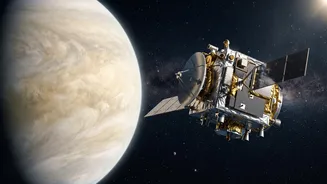
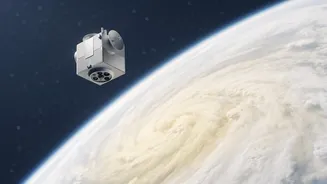
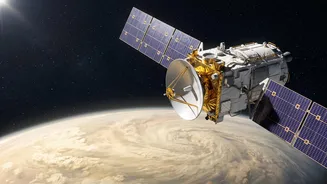
Formally approved in September 2024 and scheduled for a March 2028 launch, Shukrayaan is India’s first dedicated mission to Venus. Following the successes of Chandrayaan (Moon) and Mangalyaan (Mars), this ambitious project aims to perform a comprehensive investigation from orbit for over four years. The primary goals are to map the planet's surface and subsurface, study the bizarre dynamics of its thick atmosphere, and examine the interaction between Venus and the solar wind. To do this, the orbiter will carry a sophisticated suite of around 19 scientific instruments, or payloads, developed both in India and through international collaborations with countries like Russia, France, Sweden, and Germany.
Peering Beneath the Clouds with Radar
One of the biggest challenges in studying Venus is its impenetrable cloud cover. Shukrayaan’s flagship instrument, a high-resolution Synthetic Aperture Radar (SAR), is designed to solve this problem. Radar can pierce through the thick atmosphere, day or night, to map the terrain below in incredible detail. This sensor will search for clues about the planet's geological history, including signs of active volcanoes, lava flows, and tectonic features. Even more groundbreaking is a plan to include a ground-penetrating radar. This would be the first time any mission has studied the subsurface of Venus, allowing scientists to investigate shallow geological layers and structures hidden from view.
Decoding the Toxic Atmosphere
Shukrayaan is equipped with several instruments to 'sniff' and analyse the Venusian atmosphere's composition. A key payload is the Venus Infrared Atmospheric Gases Linker (VIRAL), a joint effort between Russia and France. This sensor will study the chemical makeup of the clouds and search for trace gases. Its targets include sulfur dioxide and carbon dioxide, which drive the planet's extreme climate, and even phosphine. The controversial detection of phosphine in 2020 sparked a debate about the possibility of microbial life floating in the cooler upper atmosphere, and VIRAL's measurements could provide crucial data to this intriguing mystery. Other instruments will monitor cloud movements, map thermal emissions to identify hotspots, and even look for lightning.
Studying the Solar Wind Connection
Unlike Earth, Venus has no significant magnetic field to protect it from the constant stream of charged particles from the Sun, known as the solar wind. This direct interaction strips away parts of the planet’s upper atmosphere and is a key factor in why Venus lost its water over billions of years. To understand this process better, Shukrayaan will carry payloads developed in collaboration with Sweden and Germany. The VISWAS and RAVI instruments will analyse how the solar wind affects the Venusian ionosphere—the charged upper layer of its atmosphere. These sensors will measure plasma particles and the structure of the ionosphere, giving us a clearer picture of how Venus's atmosphere is slowly being eroded into space.