





A Glimpse of a Cosmic Metropolis
Imagine trying to understand how a skyscraper is built by only ever seeing the finished product. That’s been the challenge for astronomers studying galaxy clusters, the largest structures in the universe bound together by gravity. These cosmic cities
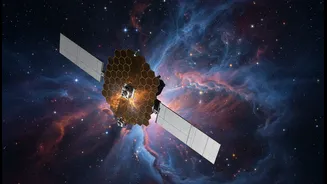
can contain thousands of galaxies, but we usually only see them in their modern, mature state. Now, a stunning new observation from the JWST, in partnership with NASA's Chandra X-ray Observatory, has captured a 'protocluster' in the act of forming. It’s like watching the assembly line for the first time, giving scientists an unprecedented look at how these massive structures came to be.
Meet JADES-ID1
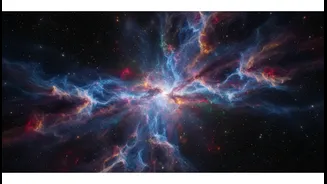
The subject of this incredible observation is a protocluster named JADES-ID1. What makes it so remarkable is not just what it is, but when it is. The light from JADES-ID1 has traveled for 12.7 billion years to reach us, meaning we are seeing it as it was only about a billion years after the Big Bang. At this early stage, it was already a bustling hub of activity. Webb’s powerful infrared eyes identified at least 66 potential galaxies being drawn together by gravity. The Chandra telescope provided the clinching evidence, detecting a colossal cloud of superheated gas bathing the entire system—a key feature of a developing cluster.
Too Big, Too Soon?
The very existence of JADES-ID1 is a beautiful puzzle for scientists. With a mass estimated to be around 20 trillion times that of our Sun, this protocluster is far more developed than anyone expected for that early epoch. According to many cosmological models, the universe simply shouldn't have had enough time or material to assemble such a massive structure so quickly. Discovering this cosmic heavyweight is like finding a fully grown redwood tree in a field where you only expected to see saplings. It suggests, as one scientist put it, that the early universe was in "a huge hurry to grow up." This finding forces a major rethink of the timelines for cosmic construction.
The Power of Two Telescopes
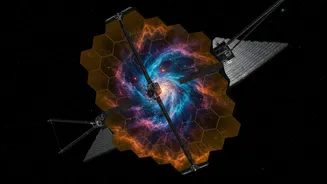
This discovery was a team effort, not just of scientists, but of telescopes. Webb is the master of detecting the faint infrared light from the most distant galaxies, a light that has been stretched over billions of years as the universe expanded. It could spot the individual galactic building blocks of JADES-ID1. But a cluster is more than just galaxies; it’s also the hot gas that exists between them. This gas is invisible to Webb but shines brightly in X-ray light. That’s where the Chandra X-ray Observatory came in, spotting the massive gas halo and confirming that this was indeed a protocluster in the making. It’s a perfect example of how different instruments working together can reveal a more complete picture of the cosmos.
Rewriting Cosmic History
So, what does this all mean? The discovery of JADES-ID1 joins a growing body of evidence from Webb that the early universe was more complex and evolved faster than we thought. From surprisingly massive early galaxies to black holes that seem to form before their host galaxies, Webb is consistently showing us that the cosmic dawn was a busy and dramatic period. Each new observation provides a vital data point that helps refine our models of how everything we see today came into existence. These aren't just pretty pictures; they are fundamental clues to our own cosmic origin story, challenging assumptions and opening up exciting new questions for astronomers to investigate.