




The Eight-Minute Delay
It’s a concept so mind-bending it sounds like science fiction, yet it’s happening every second of every day. The light from the Sun, the very energy that powers life on Earth and warms your face, does not arrive here instantly. It travels across the vast
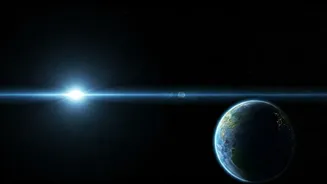
emptiness of space at the fastest speed possible in the universe—the speed of light. That speed, approximately 300,000 kilometres per second, is almost incomprehensibly fast. But space is incomprehensibly vast. The average distance between the Sun and Earth is about 150 million kilometres. A quick calculation (distance divided by speed) reveals the journey time: roughly 499 seconds, or about 8 minutes and 20 seconds. This means that every ray of sunshine you experience is, in a very real sense, from the past. If the Sun were to suddenly vanish, we on Earth would continue to enjoy its light and warmth, completely unaware, for over eight minutes. It’s a built-in cosmic delay that constantly reminds us of the scale of our solar system.
The Incredible Journey of a Photon
So what is this 'cosmic light'? It’s made of countless tiny packets of energy called photons. These photons are born in the Sun’s core, a place of unimaginable temperature and pressure where hydrogen atoms are fused together to create helium. This nuclear fusion process releases a tremendous amount of energy, creating the photons that eventually reach us.
But the eight-minute journey through space is only the final, triumphant sprint of a marathon that is almost too long to imagine. Before a photon can even begin its trip to Earth, it must first escape the Sun itself. This is no easy task. The Sun's interior is incredibly dense, a chaotic plasma of particles. A newly created photon doesn’t travel in a straight line. Instead, it gets absorbed and re-emitted by atoms, bouncing around in a random, staggering path known as a 'random walk'.
A Journey of a Hundred Thousand Years
This chaotic journey from the Sun's core to its visible surface (the photosphere) can take an astonishingly long time. While the eight-minute trip to Earth is quick, scientists estimate that the initial escape from the Sun’s interior can take anywhere from 10,000 to over 100,000 years. Think about that: the specific ray of sunshine that just warmed your hand might have been created inside the Sun’s core when our distant ancestors were just beginning to develop agriculture or paint on cave walls.
The light we see today is ancient history from the Sun's perspective, even before it starts its final dash across the solar system. It’s a relic, carrying energy that was generated in a bygone era, finally released to make its way to our world.
Living in the Past
This time delay isn’t unique to our Sun. It’s a fundamental principle of observing the universe. Because light takes time to travel, everything we see in the cosmos is a snapshot of the past. When we look at Proxima Centauri, the nearest star to our solar system, we are seeing it as it was over four years ago. When we gaze at the Andromeda Galaxy, our closest major galactic neighbour, we are seeing light that is 2.5 million years old. The farther we look into space, the further back in time we are peering.
The James Webb Space Telescope is designed to capitalize on this, capturing light from the very first galaxies that formed over 13 billion years ago. Our simple, everyday experience with an eight-minute-old sunbeam is a direct, personal connection to this profound astronomical reality. We are all time travellers, just by looking up.