



A long train journey across India is an experience in itself, but a dead phone or laptop can quickly turn scenic views into a stressful situation. Here’s your complete guide to staying powered up and connected from start to finish.
Know the Rules: The 11 PM to 5 AM Charging Blackout
First, the most critical
piece of information: Indian Railways has a rule that requires charging points in train coaches to be switched off between 11 PM and 5 AM. This long-standing safety measure, recently reinforced after a power bank explosion incident, is designed to prevent fire hazards from devices left charging unattended overnight. This means you cannot rely on train sockets for overnight power. Passengers are advised to charge their devices before 11 PM or after 5 AM. Staff are instructed to ensure compliance, and surprise inspections are conducted to enforce the rule. Planning your charging schedule around this six-hour window is your first step to a stress-free journey.
Your Best Friend: The Power Bank
Since you can't charge overnight using the train's power, a reliable power bank isn't just a good idea—it's essential. For long journeys, a capacity of 10,000mAh is a good starting point, capable of charging most smartphones two to three times. For travellers with multiple devices or those on multi-day trips, a 20,000mAh power bank provides a more substantial buffer. Brands like Xiaomi, Ambrane, and boAt are popular choices in India, offering a balance of capacity, fast charging, and value. Remember that the rated capacity isn't the same as the output; a 20,000mAh power bank delivers around 12,000-13,000mAh to your devices due to energy loss during transfer. Always pack a fully charged power bank before you leave home.
Scout Your Socket: Finding Charging Points on the Train
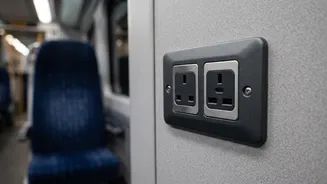
Knowing where to find charging points can save you a lot of hassle. The availability varies significantly by coach class. In Sleeper Class (SL), sockets are scarce. You might find only a couple of points per bay, meaning eight passengers could be competing for one or two outlets. In AC 3-Tier (3A) and AC 2-Tier (2A) coaches, availability is better, with more sockets distributed throughout the compartment. However, even in AC coaches, you may not have a dedicated socket for your berth, so be prepared to share. Newer LHB coaches and premium trains like Vande Bharat generally offer better infrastructure, sometimes with a socket for each seat or berth. The key is to plug in your devices whenever a socket is free during the permitted hours (5 AM to 11 PM).
Charge Safely and Smartly
When you do get access to a charging point, exercise caution. Use your original charger or a certified, high_quality adapter. Train power can sometimes have voltage fluctuations, and a good adapter helps protect your device. While the risk of 'juice jacking' (data theft through a compromised public USB port) is low from a standard three_pin socket, it's always wisest to plug your own adapter into the wall socket rather than using a public USB port directly, if available. Never leave a device charging unattended, as this not only makes it a target for theft but is also a safety risk. If a socket appears loose, damaged, or sparks, avoid it and inform the train staff.
Conserve Power Like a Pro
The simplest way to keep your devices powered is to use less battery. Switch your phone to 'Airplane Mode' when you don't need a signal, as constantly searching for a network in areas with patchy coverage is a major battery drain. Enable 'Low Power Mode' or 'Battery Saver Mode' to automatically reduce background activity. Before your trip, download movies, music, and maps for offline use to avoid power-'hungry streaming and data usage. Dimming your screen brightness and turning off unnecessary notifications, Bluetooth, and location services are other simple yet effective tricks to extend your battery life significantly.