

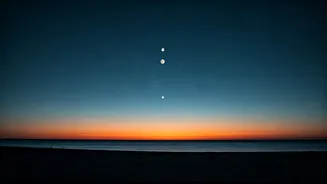
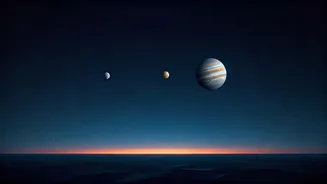


What Exactly Is a Planetary Lineup?
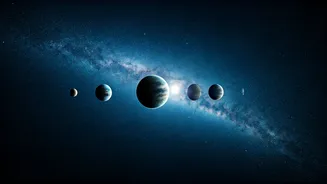
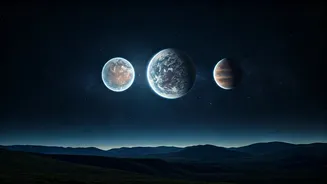
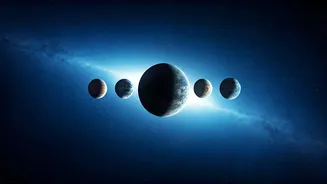
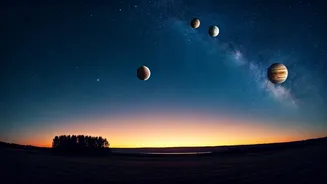
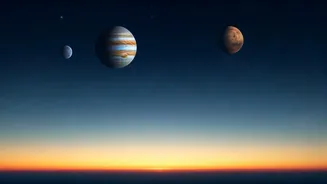
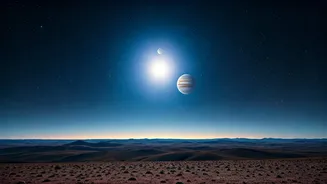
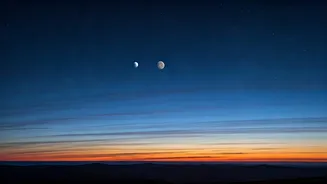
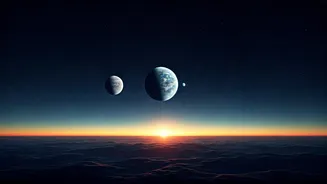
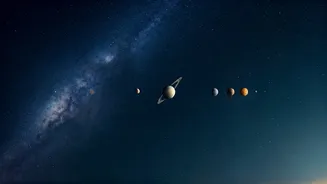
A planetary lineup, often called an alignment or parade, occurs when several planets appear close together in the same small sector of the sky from our viewpoint on Earth. It's important to know they aren't actually forming a perfectly straight line in space—that's
incredibly rare. Instead, as the planets follow their own orbits around the Sun, they sometimes end up in the same general direction from our perspective. Imagine them as runners on a vast, circular track; occasionally, a few of them will be clustered in the same curve of the stadium. This gives us the beautiful and rare opportunity to spot multiple worlds in a single glance, without needing to turn our heads.
When and Where to Look From India
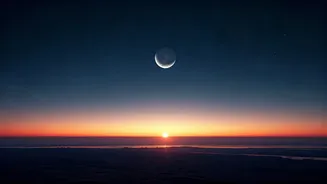
The best time to view most planetary lineups is during a specific window either just after sunset or just before sunrise. For an evening alignment, you'll want to start looking about 30 to 45 minutes after the sun has completely set. Find a spot with an unobstructed view of the western horizon, as this is where the sun disappears and where the planets will likely be visible before they too set for the night. For a morning alignment, you'll need to be an early riser. Look towards the eastern horizon about 45 to 60 minutes before sunrise. The planets will appear as bright, steady points of light against the slowly brightening dawn sky. Check a reliable astronomy app or website for the exact timings for your city, as they can vary slightly based on your location.
Meet the Planets on Display
While the exact cast of planets can change with each lineup, you can typically identify them by their unique characteristics. Unlike stars that twinkle, planets shine with a steady, unwavering light. Here's a quick field guide:
- **Venus:** Often the brightest object in the sky after the Sun and Moon. It's unmistakable and usually appears as a brilliant, silvery-white jewel.
- **Jupiter:** The second-brightest planet. It glows with a powerful, steady, cream-coloured light. Even with good binoculars, you might be able to spot its four largest moons as tiny pinpricks of light nearby.
- **Saturn:** Noticeably fainter than Jupiter and Venus, Saturn shines with a calm, yellowish-white light. While you need a telescope to see its famous rings, its distinct colour makes it identifiable.
- **Mars:** The Red Planet lives up to its name, glowing with a distinct reddish or orange hue. Its brightness can vary greatly depending on how close it is to Earth in its orbit.
- **Mercury:** The most elusive planet, as it's always close to the Sun. It appears as a small, star-like point of light, visible only for a short time during twilight, low on the horizon.
Do I Need a Telescope?
The wonderful thing about most planetary lineups is that they are fantastic naked-eye events. You do not need a telescope or any special equipment to see the planets themselves. They will appear as bright stars. However, if you have a pair of binoculars, they can significantly enhance your experience. Binoculars will make the planets appear as small, sharp discs of light rather than points, and you might even resolve some details, like the moons of Jupiter. A small telescope, of course, will open up a new world, revealing Saturn’s rings or the cloud belts of Jupiter. But don’t let a lack of equipment stop you; the simple act of seeing multiple planets with your own eyes is the real prize.
Tips for Urban Skygazers
Viewing celestial events from a bustling Indian city can be challenging due to light pollution, but it's not impossible. First, try to find the darkest spot you can access safely. This could be a park, a quiet field on the outskirts of town, or even the terrace of a tall building that rises above the worst of the street-level glare. Second, give your eyes time to adapt. Once you're in your spot, avoid looking at your phone or any bright lights for at least 15-20 minutes. This allows your pupils to dilate and become more sensitive to faint light, making the planets and brighter stars easier to spot. Finally, patience is key. The sky that looked empty at first will slowly reveal its treasures as your eyes adjust.