






The Real Reason for the Seasons
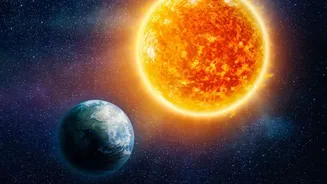
First, let's clear up a common myth. The seasons are not caused by how close the Earth is to the sun. In fact, in the Northern Hemisphere, Earth is actually closest to the sun in January, during the middle of winter. The true cause of the seasons is far
more elegant: the Earth’s tilt. Our planet spins on an axis that is tilted at an angle of about 23.5 degrees relative to its orbital plane. This tilt is constant, always pointing in the same direction as Earth makes its year-long journey around the sun. This simple fact—that our planet is tilted—is the engine that drives the seasonal changes we experience all year long, from the longest day of summer to the shortest day of winter.
A Year-Long Celestial Dance
Imagine Earth’s journey around the sun. Because of its unwavering tilt, there are times of the year when the Northern Hemisphere is angled more directly toward the sun, and other times when it’s angled away. When our hemisphere is tilted toward the sun, we receive more direct, concentrated sunlight. The sun's path appears higher in the sky, leading to longer days and warmer temperatures—what we call summer. Conversely, when our hemisphere is tilted away from the sun, the sunlight hits us at a shallower angle, spreading the energy out. This results in shorter days, a lower sun in the sky, and the cooler temperatures of winter. The seasons, therefore, are a direct consequence of which part of the planet is getting the most direct solar energy.
What Makes an Equinox Special
Twice a year, Earth reaches a point in its orbit where its axis is tilted neither toward nor away from the sun. At these moments, the sun shines directly over the Earth’s equator. This event is called an equinox. The word comes from Latin, meaning “equal night,” because on the day of the equinox, day and night are approximately equal in length all over the world. This isn't a day-long event, but a specific moment in time. The upcoming autumnal equinox for the Northern Hemisphere will occur on September 22, 2026, at 8:04 P.M. EDT. For the Southern Hemisphere, this same moment marks the beginning of spring. This is the point of seasonal balance before one hemisphere begins to tilt away from the sun again, ushering in winter.
Equinoxes vs. Solstices
The equinoxes are the balancing points in our planet's orbit, but they have opposites: the solstices. While the two equinoxes in March and September mark the start of spring and autumn, the two solstices in June and December mark the start of summer and winter. The solstices are the moments of maximum tilt toward or away from the sun. The summer solstice is the longest day of the year, when the sun is at its highest point in the sky. The winter solstice is the shortest day of the year, when the sun is at its lowest. Together, the two equinoxes and two solstices are the four key turning points that define our astronomical seasons.
What to Look For in September
The September equinox is more than just a date on the calendar; it brings observable changes. Everywhere on Earth, the sun will rise almost exactly in the east and set almost exactly in the west on this day. You'll also notice the sun's arc across the sky is shifting southward. The most obvious change is the rapid loss of daylight. In many parts of the country, days become noticeably shorter as nights grow longer, a trend that continues until the winter solstice in December. For many, this celestial event is also a cultural marker, a time to acknowledge the harvest and prepare for the coming cold. It’s a global signal that the Earth is continuing its constant, beautiful, and predictable journey through space.