

A New Class of Worlds
The focus of this groundbreaking research is a class of planets known as 'super-Earths'. Our own solar system curiously lacks one, yet they are among the most common types of planets discovered in our galaxy. As the name suggests, these are worlds more
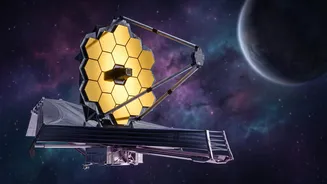
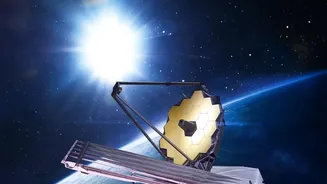
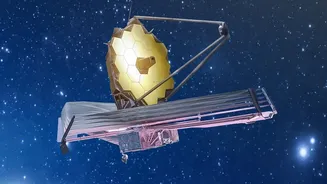
massive and larger than Earth but smaller than our ice giants like Neptune. They are incredibly diverse: some are scorching hot lava worlds orbiting perilously close to their star, while others might be dense, rocky planets or even water worlds. Scientists see them as prime targets in the quest for habitable environments, as their size gives them a good chance of holding onto a significant atmosphere. The JWST's powerful infrared instruments are finally allowing us to move beyond simply finding these planets to actively characterising what their atmospheres are made of.
How to Analyse a Distant Atmosphere
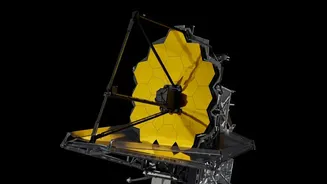
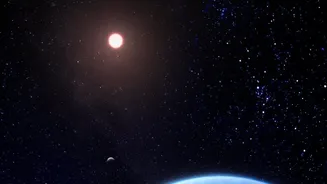
Analysing the air of a planet light-years away sounds like science fiction, but the method, known as transit spectroscopy, is ingeniously simple in concept. When an exoplanet passes, or 'transits', in front of its host star from our viewpoint, a tiny amount of starlight filters through the planet's atmosphere. Different molecules in that atmosphere absorb specific wavelengths, or colours, of light. The JWST’s Near-Infrared Spectrograph (NIRSpec) is exceptionally sensitive to these minute changes. By capturing the spectrum of the starlight before and after it passes through the planetary atmosphere, astronomers can identify the chemical fingerprints left behind by molecules like water vapour, methane, and carbon dioxide. It is akin to figuring out the ingredients of a dish by analysing the light that passes through the steam rising from the pot.
Water, Water, Everywhere?
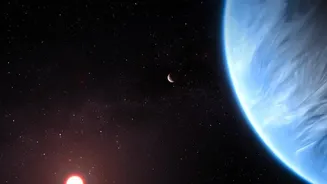
Recent observations have delivered spectacular proof of this technique's power. JWST has confirmed the presence of water vapour in the atmospheres of several super-Earths and similar exoplanets. One prominent example is K2-18 b, a world about eight times the mass of Earth where the telescope detected not just water vapour but also methane, leading scientists to classify it as a potential 'Hycean' world—a planet with a possible liquid water ocean under a hydrogen-rich atmosphere. On another planet, GJ 1214 b, the telescope pierced through a thick haze that had previously hidden its composition, revealing strong evidence that the atmosphere is primarily made of steam. However, this detection of water doesn't automatically mean life. Many of these planets, like GJ 486 b, are far too hot for liquid water to exist on their surfaces, with temperatures reaching hundreds of degrees Celsius.
A Milestone, Not a Destination
The true significance of these findings is not that we have found a new Earth, but that we have proven our technology can perform these incredible feats of remote chemical analysis. Detecting water on a rocky exoplanet, even an inhospitable one, is a monumental technical achievement. Each detection serves as a crucial proof of concept, refining the techniques astronomers will use to scan dozens of other worlds. While water has been detected on gas giants before, successfully analysing the thinner atmospheres of rocky planets is a giant leap forward. The challenge is immense; sometimes, the signal is so faint that scientists must carefully rule out whether the water signature is coming from the planet's cool star rather than the planet itself. But the ability to even ask and investigate such a question is revolutionary.