



Why the Monsoon is a Fermenter's Foe
Fermentation is a delicate dance between good bacteria and their environment. The monsoon season, with its persistent dampness and high humidity, tips the scales in favour of unwanted guests like mold and harmful yeasts. Mold spores are everywhere in the air,
but they thrive and multiply in moist conditions. This means that during the monsoon, your kitchen is a high-risk zone. Every time you open your crock, you're potentially introducing a higher concentration of these airborne spores. The warmer ambient temperature can also speed up fermentation unpredictably, making it a tricky period for even seasoned fermenters.
Start with a Spotless Crock
Your first line of defence is a meticulously clean crock. Before you begin, wash your crock, lid, and fermentation weights with hot, soapy water. For porous unglazed stones or lids, soap and water might not be enough to eliminate lingering spores from previous batches. For a deeper clean, you can boil the stones and lid in a solution of water and white vinegar for at least 10 minutes. Afterwards, allow everything to air dry completely; using a towel can introduce new bacteria. A thoroughly sterilised vessel gives your ferment the clean start it needs to ward off invaders.
Master the Brine and Submersion
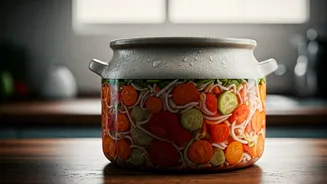
The two golden rules of vegetable fermentation are: correct salt ratio and complete submersion. Salt is crucial as it creates an environment where beneficial lactic acid bacteria can flourish while inhibiting harmful microbes. A weak brine is an open invitation for mold. Aim for a salt concentration of 2-5%, depending on your recipe. Equally important is keeping all your vegetables fully submerged beneath the brine. Mold needs oxygen to grow. Any vegetable matter exposed to air is a potential landing pad for spores. Use fermentation weights to ensure everything stays safely under the liquid, creating an oxygen-free zone where good bacteria can work their magic.
Choose Your Location Wisely
Where you place your crock matters, especially during the monsoon. Find a cool, dry, and dark spot away from direct sunlight and humidity. Avoid placing it near windows or in damp corners of the kitchen. Storing crocks on a low shelf in an inner pantry is often a good choice. Consistent temperature is key. The area around appliances like refrigerators or gas stoves can be warmer, which might accelerate fermentation too quickly. A stable, less humid environment helps ensure a slow, controlled, and successful ferment.
Recognise the Difference: Kahm Yeast vs. Mold
Opening your crock to find a film on top can be alarming, but don't panic. You need to learn the difference between harmless Kahm yeast and dangerous mold. Kahm yeast appears as a thin, white, wrinkly, or powdery film on the surface. It's generally harmless, though it can affect the flavour if left to grow. It can be skimmed off carefully. Mold, on the other hand, is a deal-breaker. It looks fuzzy and can be white, green, blue, or black. If you see fuzzy, colourful patches, it is a sign of spoilage. Unlike Kahm yeast, mold can produce harmful mycotoxins that penetrate deep into the food, so the entire batch must be discarded.
Consider Using an Airlock
While traditional crocks with moats work well, the high humidity of the monsoon might call for extra protection. Using a fermentation vessel with an airlock lid can be a game-changer. Airlocks are one-way valves that allow the carbon dioxide produced during fermentation to escape while preventing oxygen and airborne spores from getting in. This creates a more secure, anaerobic environment, significantly reducing the risk of surface mold and contamination. This can be especially helpful for beginners or anyone struggling with recurring mold issues during humid weather.